
Save 5–15% Fuel After a Remap: Ask Tuners for an Economy Map
A remap will not automatically make your car use more fuel. It depends entirely on what the map is built for: an economy map, matched to your engine and driving style, tends to lower consumption, while a power-focused map that chases horsepower usually pushes it up. The genuine answer sits in the map’s goal, not the act of remapping itself. If economy is your priority, the section on requesting an economy-focused remap below tells you exactly what to ask for.
TL;DR:
An economy remap typically reduces fuel consumption by around 5 to 15 percent when paired with steady driving and good engine health.
Diesel engines respond more positively to economy maps due to their low-RPM torque, while petrol engines, especially naturally aspirated, have less room for efficiency gains.
Aggressive driving, higher speeds, or using the wrong fuel can negate or reverse the fuel savings intended by an economy remap.
Preventative engine maintenance, including carbon cleaning and checking emissions hardware, is essential before remapping to ensure optimal fuel efficiency.
Requesting a tailored remap with baseline and post-installation MPG logs, and clear documentation, increases the likelihood of achieving genuine fuel savings.
Table of Contents
Does remapping affect fuel economy through the ECU?
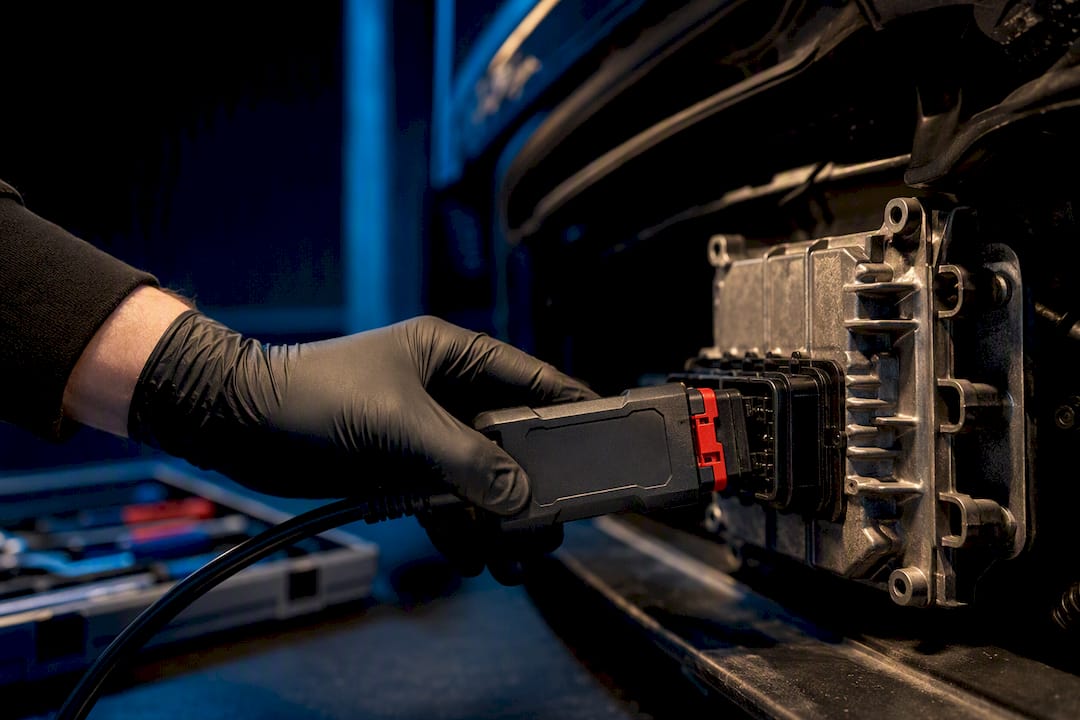
Every modern engine runs on decisions made by its ECU (engine control unit), which governs fuel injection timing, ignition advance, and (on turbocharged engines) boost pressure. Remapping rewrites the software behind those decisions. Nothing physical changes inside the engine, but the calibration that tells it how much fuel to inject, when to spark, and how hard to push the turbo shifts entirely.
That’s why the same remapping process can push a car in opposite directions. Tighten the fuel delivery and smooth out the ignition curve for efficient combustion, and you get an economy-leaning outcome. Open the fuel map and raise boost for maximum torque, and you get more power at the cost of burning more fuel per mile.
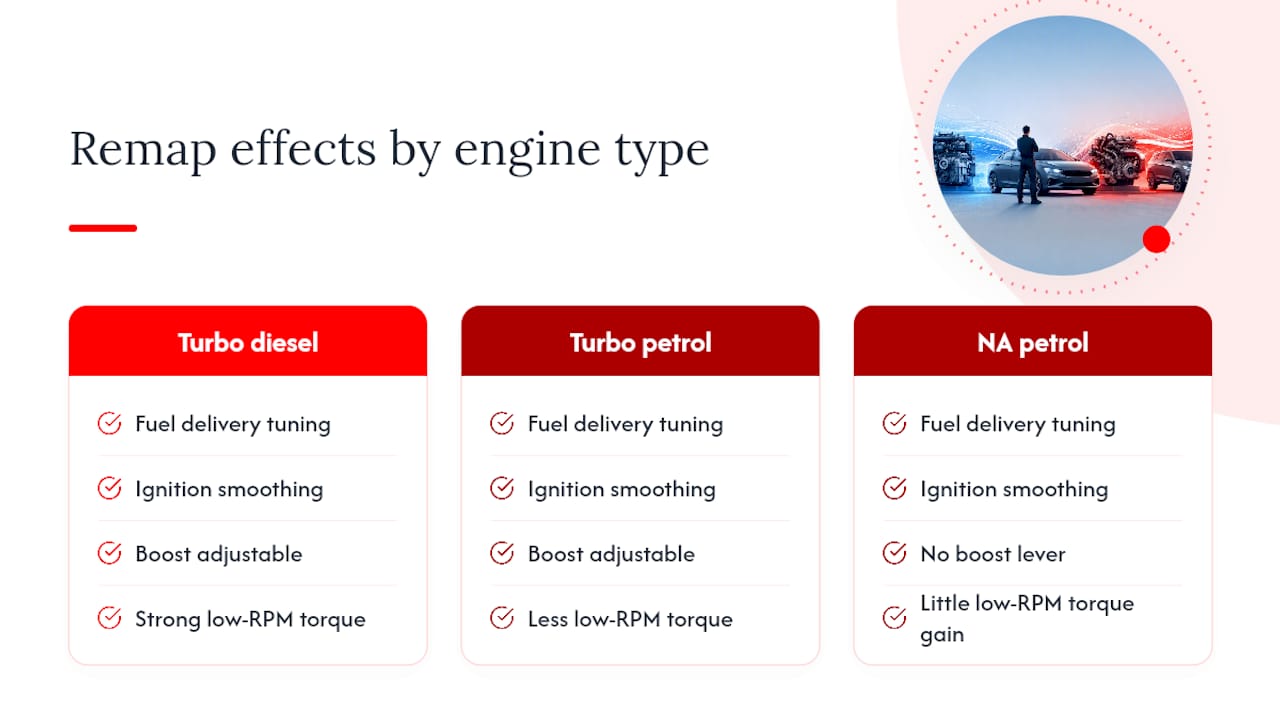
Turbocharged engines respond more dramatically than naturally aspirated ones. Boost pressure gives a tuner a second lever, on top of fuel and timing, to manipulate torque delivery. That’s partly why diesel remaps often show clearer economy gains than petrol remaps: diesels already produce strong torque at low revs, and a well-tuned map lets you cruise at lower RPM for the same road speed, which is directly beneficial for MPG. Petrol engines, especially naturally aspirated ones, have less room to manoeuvre because there’s no boost curve to reshape.
What determines whether fuel use rises or falls?
Several variables decide which way your fuel bill moves after a remap, and most of them have nothing to do with the tuning file itself.
Map objective. An economy map targets smoother torque delivery and reduced fuel injection at cruising speed; a performance map targets peak power and typically increases fuel use under load.
Driver behaviour. A car with sharper throttle response invites harder acceleration, and aggressive driving after a remap can erase any efficiency gain the map was designed to deliver.
Engine type and condition. A diesel with a clean DPF and EGR system responds better to an economy map than one already struggling with clogged emissions hardware.
Usage pattern. Motorway cruising rewards an economy map’s smoother torque curve; stop-start urban driving dilutes the benefit because you spend more time accelerating from rest.
Fuel grade and emissions hardware. Running the wrong fuel grade or a car with faulty sensors can undermine the calibration a remap assumes you’re running.
Pro Tip: Book your remap conversation around how you actually drive, not how you’d like to drive. Tell the tuner honestly whether it’s mostly motorway miles or school-run traffic. That single detail shapes the map more than any spec sheet.
How much can MPG change after a remap?
Reported economy improvements from a well-matched remap commonly fall in the 5 to 15% range, with diesels often at the higher end thanks to their low-RPM torque advantage. That figure assumes an economy-focused map, steady driving, and an engine in good mechanical health. It is not a guaranteed outcome for every vehicle.
The other side of that coin: a power-focused remap, or the same map paired with heavier-footed driving, can increase consumption noticeably. Aggressive acceleration and higher cruising speeds after a remap can push fuel use up by a wide margin, and in some cases wipe out any theoretical saving entirely.
A worked example makes the trade-off concrete. Take a diesel doing 45 MPG and 12,000 miles a year on mostly motorway journeys.
At 45 MPG, that’s roughly 267 gallons of diesel annually.
A 10% economy improvement brings that to about 49.5 MPG, saving around 27 gallons a year.
At current diesel prices, that’s a meaningful dent in the annual fuel bill, though the exact saving depends on prices at the pump when you fill up.
Against a one-off remap cost, most economy-focused customers recoup the outlay within a year or two of typical mileage, assuming the map holds and driving style stays consistent.
Can a remap wear out your engine and cost you fuel later?
Yes, if the map pushes the engine harder than its components were designed for. Raising boost pressure, advancing ignition timing, or increasing injection pressure all put extra load on parts that weren’t built with much margin to spare.
Turbos are usually the first casualty. Sustained higher boost accelerates bearing wear and can shorten the unit’s working life. Injectors face similar strain under increased fuel pressure. Once these components start degrading, they rarely fail in a way that improves fuel economy. A tired turbo that’s lost sealing efficiency, or injectors delivering an uneven spray pattern, both tend to push consumption the wrong way, quietly, over months rather than overnight.
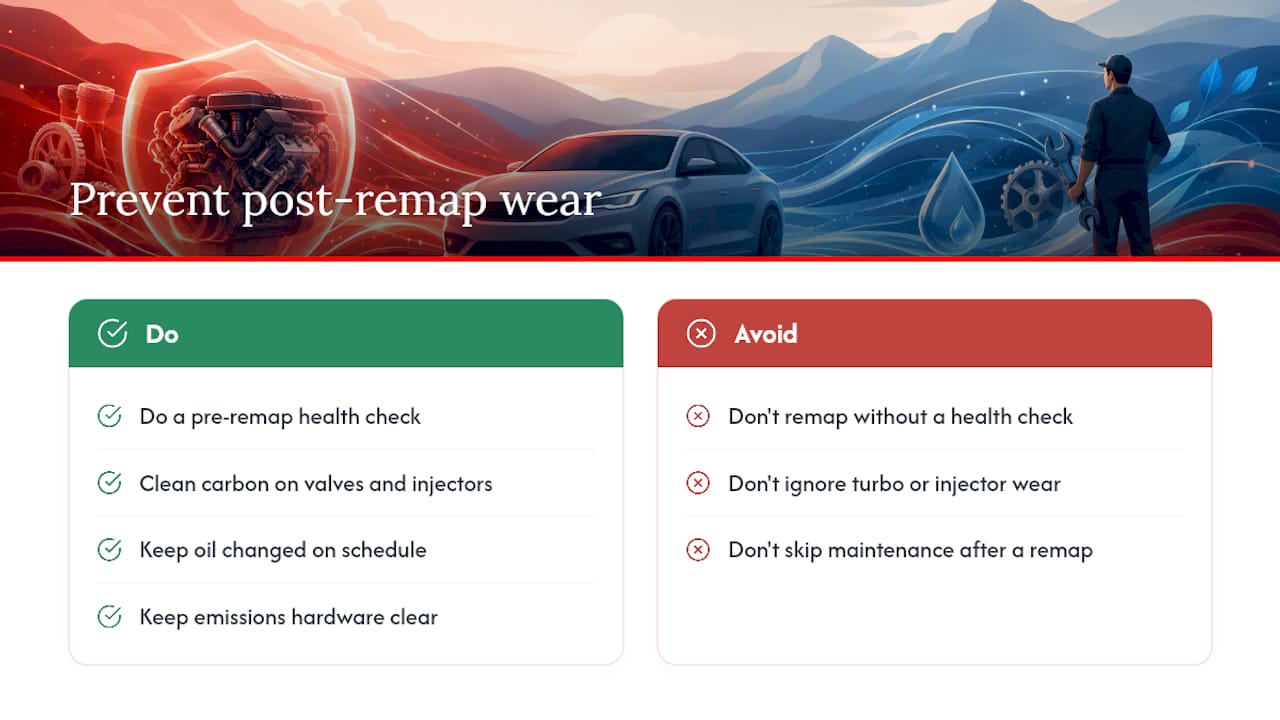
The fix is prevention rather than cure. A pre-remap health check catches problems before they get baked into a new calibration: oil condition, DPF status, and general engine cleanliness all affect how well a map performs and how long it keeps performing that way. Carbon build-up on inlet valves and injectors is a common, overlooked culprit behind post-remap disappointment, and it’s one of the few issues a simple service step can resolve before tuning even begins.
Regular maintenance after the remap matters just as much. An engine running a more aggressive fuel or boost strategy needs its oil changed on schedule and its emissions hardware kept clear, because a map that assumed a healthy engine will not behave the same way once that engine starts to slip.
How do you request an economy-focused remap?
Getting the outcome you actually want means being specific with your tuner, not just booking “a remap” and hoping for the best.
State the goal upfront. Tell the tuner you want an economy map, not a power map, and explain your typical driving (motorway, urban, mixed).
Ask for baseline logging. A proper tuner will record your MPG before the remap and offer a comparison afterwards, so the result is measurable rather than anecdotal.
Ask about their process. Find out whether they use a dyno, live data logging, or both, and how they tailor the file to your specific vehicle rather than applying a generic map.
Check the rollback and warranty position. A reputable tuner can revert the map if something isn’t right and will be upfront about what a remap does to your existing warranty position.
Get the changes documented. You should leave with a clear note of what was altered, not just a verbal assurance that “it’s been done.”
Pro Tip: Walk away from anyone who promises big power gains with zero mention of economy trade-offs, or who can’t explain how they’ll test the result. That’s usually a sign of a generic file, not a tailored one.
What does Performance Tuning NI actually deliver?
Performance Tuning NI specialises in custom remaps for both petrol and diesel engines, using modern tuning techniques rather than off-the-shelf files. The business has tuned thousands of vehicles and holds a five-star Google rating, built on repeat custom work rather than a single generic approach.
Customers typically report sharper throttle response and smoother power delivery after a remap, alongside the potential for improved economy when the map is tailored that way from the outset. That distinction between a generic file and a bespoke calibration is exactly what separates a remap that saves fuel from one that burns more of it.
Is a fuel-saving remap worth chasing, or just a myth?
A remap genuinely can lower your fuel bill, but only when the map is built for that purpose and your driving cooperates with it. Chase power instead, or drive harder because the car suddenly feels livelier, and consumption goes the other way. If economy is the goal, say so clearly and book with a tuner who tests and documents the result. The next section covers exactly how to arrange that with Performance Tuning NI, and the FAQ below answers the questions readers ask most.
— Mark
Book an economy remap that’s built to save fuel, not just add power
Economy-focused remapping alongside engine carbon cleaning is typically available, often with options for standard and mobile appointments to suit different schedules and locations.
[
If a poorly running engine is behind disappointing MPG in the first place, carbon cleaning clears the build-up that a remap alone can’t fix, and it’s worth raising with your tuner before any tuning file goes on. When you book, ask for a documented economy map with a pre and post MPG check logged against your baseline, exactly the approach that separates a genuine fuel-saving remap from a generic power file. Head to the engine remapping and ECU tuning page to see what’s involved and get a bespoke map booked in around your driving needs.
Sources
FAQ
Will a remap definitely increase my fuel consumption?
No. A remap tuned for economy can lower consumption, while a remap tuned for power, or paired with harder driving, tends to increase it.
How does remapping change MPG in practical terms?
It alters fuel injection, ignition timing, and (on turbocharged engines) boost pressure, which changes how efficiently the engine burns fuel at a given speed or load.
What percentage fuel saving can I realistically expect?
Well-matched economy remaps commonly report 5 to 15% improvements, with diesels often nearer the higher end due to their low-RPM torque advantage.
Does driving style really matter that much after a remap?
Yes. Sharper throttle response can tempt harder acceleration, and aggressive driving after a remap can cancel out or exceed any fuel saving the map was built to deliver.
Can Performance Tuning NI set up a remap specifically for economy?
Performance Tuning NI builds custom remaps for petrol and diesel engines and can tailor a map towards economy rather than outright power when that’s the stated goal.
Recommended