
Is a remap safe? What Northern Ireland car owners need to know!
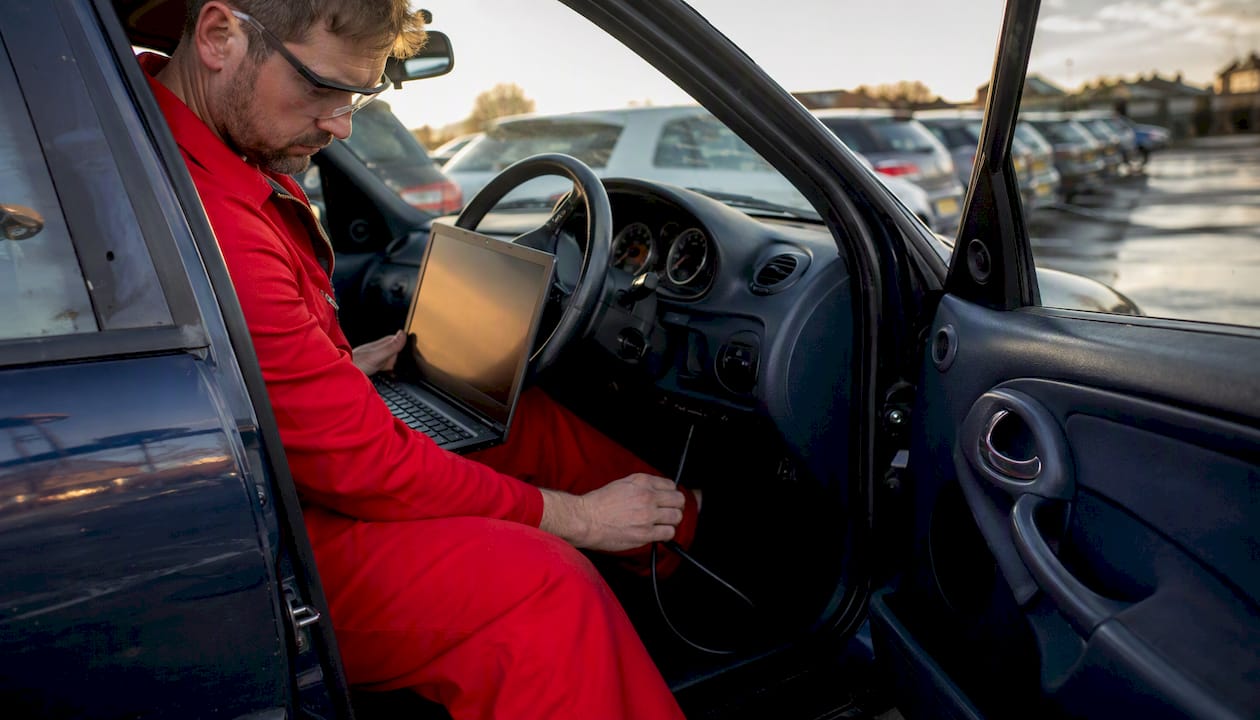
Yes, a remap can be safe. The condition is specific: the tuner must run pre-tune diagnostics, write a vehicle-specific calibration file, retain all factory emissions and safety hardware, and hand you verifiable proof in the form of datalogs or dyno charts. A generic file flashed without inspection is a different proposition entirely.
Three checks to demand before you book:
Pre-tune diagnostic scan — fault codes cleared before tuning mask problems that higher torque will expose immediately.
Datalog or rolling-road evidence — ask for before-and-after files, not just a screenshot of peak power.
Written warranty or money-back guarantee — a tuner confident in their work puts it in writing.
For most standard daily drivers on unmodified hardware, a Stage 1 remap is the appropriate starting point. It works within the tolerances of your existing engine, gearbox, and fuelling system. MOT compliance holds when DPF, EGR, and AdBlue systems remain physically intact. Insurance requires declaration, not avoidance. And oil change intervals should drop to 5,000–7,000 miles rather than the manufacturer’s extended schedule.
Table of Contents
What does ECU remapping actually change?
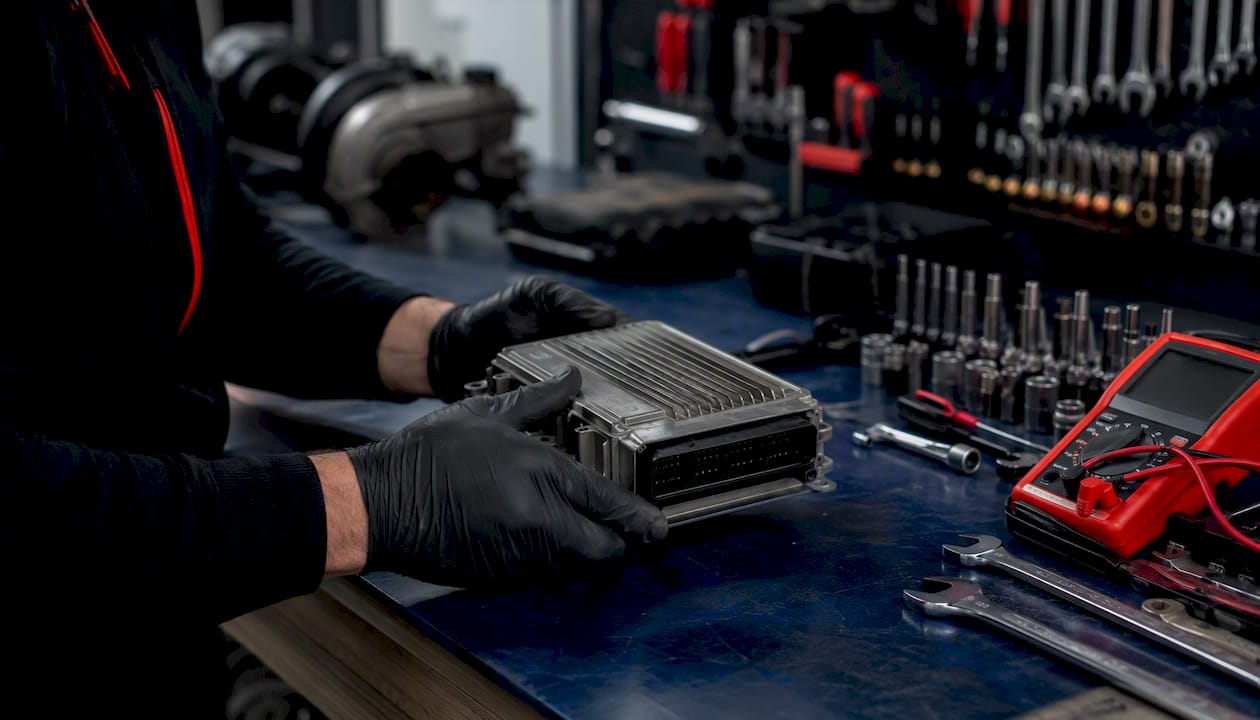
Your engine’s ECU (Engine Control Unit) governs fuel delivery, ignition timing, boost pressure, and torque request maps. From the factory, those parameters are set conservatively: manufacturers account for the worst-case fuel quality, the coldest climate their car will be sold in, and the longest service intervals their warranty must survive. A remap adjusts those calibrations to suit your specific vehicle, fuel grade, and use case.
The term “stage” describes how far the calibration departs from standard, and how much supporting hardware it assumes.
Stage | Hardware assumed | Typical risk vs gain |
Stage 1 | Standard, unmodified vehicle | Low risk; strong mid-range torque gain, improved throttle response |
Stage 2 | Upgraded intake, intercooler, exhaust | Moderate risk; higher peak figures but requires hardware to match |
Stage 3 | Turbo, injector, fuelling upgrades | High risk; significant power increase, requires full drivetrain assessment |
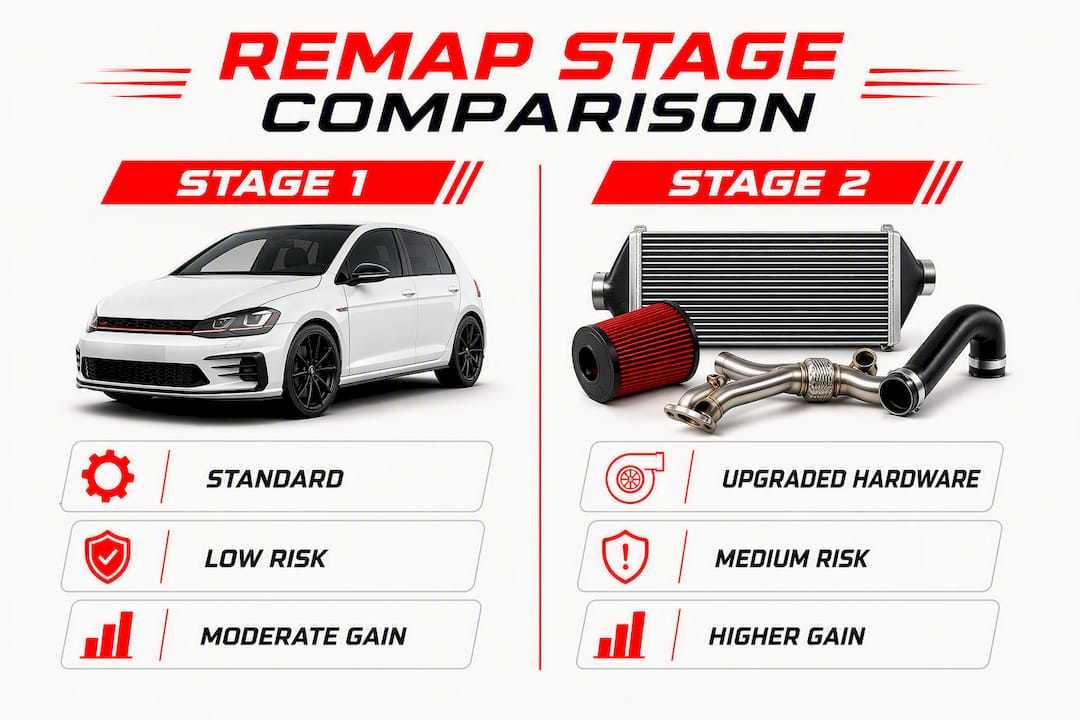
Stage 1 is designed for mechanically standard vehicles, prioritising drivability and mid-range usability rather than headline peak numbers. Stage 2 and 3 tuning assumes hardware that most daily drivers do not have, and the risk profile rises accordingly.
One point worth understanding: “stage” is a guideline, not an industry standard. Two tuners may define Stage 2 differently. What matters is whether the calibration is written for your specific vehicle’s condition, not which label it carries. Custom files matched to the vehicle are consistently safer than generic maps distributed in bulk.
What does a safe, professional remap look like step by step?
Knowing the process lets you judge whether a tuner is cutting corners. Here is what a competent, safety-first remap looks like from first contact to collection.
Pre-booking questionnaire. A serious tuner asks about service history, mileage, known faults, clutch condition, and whether the car tows or carries heavy loads. This is not small talk — it shapes the calibration strategy.
On-arrival diagnostics. Before anything is connected to the ECU, the car gets a full fault-code scan, a visual inspection for boost leaks, smoke, DPF condition, and sensor health. Higher torque exposes latent weaknesses that factory outputs tolerated; catching them first prevents failures after tuning.
Baseline datalogging. The tuner logs the car in its standard state: boost target versus actual, air-fuel ratio, knock retard, intake air temperature, and exhaust gas temperature. This is the reference point everything else is measured against.
Conservative calibration. Changes are made in increments, not in one aggressive sweep. Each revision is logged and compared against the baseline. Fuelling is kept richer under load; boost is raised gradually with knock retard monitored at every step.
Validation runs. Multiple back-to-back runs check for heat-soak effects. A tune that looks clean on a cold engine but degrades on the third run is not a safe tune. Component protection tables are confirmed active.
Delivery documentation. You leave with before-and-after power and torque charts, the datalog files, a written report, and recommended maintenance intervals. If a tuner hands you nothing but a verbal “it’s done,” that is a problem.
Pro Tip: Ask specifically for knock-retard logs and lambda traces under full-throttle load. A tuner who cannot produce these, or who seems reluctant to share them, has not done the validation work that safe tuning requires.

What can a bad remap damage, and how does risk scale?
Short-term consequences of a poorly calibrated remap include misfires, knock events, exhaust gas temperature spikes, and limp-home mode activation. In severe cases, a single sustained knock event can crack a piston or damage a bearing. These are not theoretical risks — they happen when a generic file is applied without checking whether the engine’s actual condition can support it.
Long-term effects are subtler but equally damaging:
Accelerated oil degradation. Higher cylinder pressures shear oil faster. Reputable tuners advise reducing oil change intervals to 5,000–7,000 miles for tuned engines rather than following the manufacturer’s extended schedule.
Clutch and gearbox wear. A clutch that held factory torque comfortably may slip within months after a remap if it was already near the end of its life.
Turbo longevity. Sustained overboosting without adequate fuelling raises exhaust gas temperatures and shortens turbo life.
DPF regeneration problems. Altered fuelling and exhaust temperatures can disrupt the passive and active regeneration cycles that keep a diesel particulate filter clean.
Oil change interval for tuned engines: 5,000–7,000 miles. Higher cylinder pressures accelerate oil shearing, making manufacturer long-life intervals unsafe for remapped cars.
Risk scales predictably with tune aggressiveness. Stage 1 on a well-maintained, standard vehicle carries the lowest risk profile. Stage 2 introduces hardware variables that must be verified. Stage 3 demands a full drivetrain assessment before any calibration work begins.
Practical mitigation is straightforward: use the correct fuel grade (premium unleaded or diesel as specified), avoid hard acceleration for the first 50–100 miles while the tune beds in, and keep to the shortened oil intervals. A pre-tune safety check covering brakes, tyres, and fluids is worth doing regardless of tune stage.
What are the UK legal, MOT and insurance implications?
A remap that preserves factory emissions hardware is not inherently illegal in the UK. The critical distinction is between software calibration and hardware deletion. Retaining DPF, EGR, and AdBlue systems keeps the car within MOT emissions test parameters. Removing or bypassing that hardware is a separate matter with separate legal consequences, and it is not what a road-legal remap involves.
At MOT, the test measures tailpipe emissions against type-approval limits. A software-only remap on an intact emissions system should not cause a failure. If a car fails emissions after a remap, the calibration was either too aggressive for the hardware or the emissions equipment was already compromised before tuning.
Insurance is where most owners make avoidable mistakes. Failing to declare a modification is not a grey area: it can void your policy entirely in the event of a claim. Declare the remap to your insurer before driving the car. Expect a premium increase, though the amount varies by insurer, vehicle, and tune stage. When you call:
State it as an ECU remap or software modification.
Confirm the emissions hardware remains standard and intact.
Provide the tuner’s invoice and, if asked, the dyno or datalog report.
Ask for written confirmation that the modification is noted on your policy.
Some specialist insurers are more familiar with remaps than mainstream providers and may offer more competitive terms. Keep all documentation — invoice, warranty, and log files — in case of a future claim.
If you want to understand how emissions test failures relate to vehicle modifications, that context is useful background before your MOT.
How do you choose a professional tuner worth trusting?
The difference between a safe remap and a damaging one is almost entirely down to the tuner. Price is a poor proxy for quality. Here is what to ask and what to watch for.
Questions to ask before booking:
Do you run a full diagnostic scan before tuning?
Is the file written specifically for my vehicle, or is it a generic map?
Can I see before-and-after dyno or datalog evidence?
What does your validation process involve — how many runs?
Do you provide a written warranty or guarantee?
Red flags that should stop you booking:
Reluctance or refusal to share datalog files with you.
Promises of very large power gains on a standard vehicle with no hardware changes.
Offering to delete DPF, EGR, or disable knock sensors as part of a “performance” package without clearly explaining the legal consequences.
No physical inspection before connecting to the ECU.
No written documentation at the end of the job.
Trust signals that indicate a credible operation:
Written warranty covering the calibration work.
Before-and-after power and torque charts from a rolling road.
Documented process with datalog files supplied to the owner.
Verifiable Google reviews with volume and consistency.
Demonstrable experience across a range of vehicle makes and platforms.
On pricing, Stage 1 remapping in the UK typically ranges from around £200 to £400 for most common petrol and diesel platforms, though specialist vehicles or those requiring extensive diagnostics may cost more. That range reflects legitimate variation in equipment, time, and expertise — not just margin. A tuner charging significantly below that range is cutting something, and it is usually the diagnostic and validation work.
When you collect the car, do a back-to-back comparison on a familiar road before and after. The improvement in mid-range response should be immediately noticeable. If it feels identical, ask to see the logs.
How do professional tuners engineer safety into the calibration?
This is where the engineering separates competent tuners from the rest. Three mechanisms do most of the safety work.
Lambda targets under load. Fuel acts as a coolant in turbocharged engines. Running a richer mixture under heavy load absorbs heat through evaporation and protects cylinder temperatures. Competent tuners target approximately Lambda 0.82–0.85 under full load in turbocharged applications. A lean mixture at high load is one of the fastest routes to piston damage.
Knock-retard logging. The knock sensor detects detonation events and signals the ECU to retard ignition timing. Disabling knock sensors is a known unsafe practice that removes the engine’s primary defence against catastrophic detonation. A competent tuner keeps knock sensing active, logs retard values throughout validation, and calibrates to leave adequate margin. Some retard under load is normal; sustained or large retard values indicate the tune is too aggressive for the fuel or conditions.
Component protection tables. Professional maps include active protection logic: if exhaust gas temperatures or knock thresholds are approached, the ECU automatically reduces boost or enriches fuelling. Safety is dynamic, not a static setting applied once and forgotten.
The datalog parameters you should ask to see:
Parameter | Normal range (indicative) | Red flag |
Lambda / AFR under load | 0.82–0.85 (turbo, full throttle) | Lean mixture avoided at high load |
Knock retard | 0–2° occasional | Sustained 4°+ or repeated events |
Boost target vs actual | Within a small margin | Large, consistent deviation |
Intake air temperature | Below 45°C at start of pull | Rising sharply across consecutive runs |
Exhaust gas temperature | Varies by engine; monitored for trend | Sustained spike above safe ceiling |
Pro Tip: In a datalog, look at knock retard across multiple consecutive runs. If it increases run by run, the tune has insufficient margin for heat-soak conditions. A safe calibration holds consistent retard values even as the engine warms.
Key takeaways
A remap is safe when it is vehicle-specific, preserves factory emissions hardware, and is backed by diagnostic evidence and a written guarantee.
Point | Details |
Run diagnostics first | Demand a full fault-code scan and mechanical inspection before any calibration work begins. |
Require datalog and dyno proof | Before-and-after logs are the only verifiable evidence a tune was validated safely. |
Keep emissions hardware intact | Retaining DPF, EGR, and AdBlue keeps the car MOT-compliant and road-legal. |
Shorten oil change intervals | Tuned engines need oil changes at 5,000–7,000 miles, not manufacturer extended intervals. |
Performancetuningni | Provides custom remaps with diagnostic checks, dyno/datalog evidence, and a written guarantee. |
A remap is probably not safe for your vehicle right now if it has a poor service history, a slipping clutch, persistent DPF warning lights, or unresolved fault codes. Fix those first.
The case for proof over promises in engine tuning
Most of the anxiety around remapping comes from a reasonable place: you cannot see software, and you cannot feel the difference between a conservative calibration and an aggressive one until something goes wrong. That information gap is exactly what bad operators exploit.
The conventional wisdom says “find a reputable tuner with good reviews.” That is true but incomplete. Reviews tell you whether previous customers were happy; they do not tell you whether those customers will still be happy in 40,000 miles. The more useful question is whether the tuner can show you the engineering work behind the result. Datalogs, lambda traces, knock-retard logs across multiple runs — these are not optional extras. They are the evidence that the calibration was validated rather than guessed.
There is also a widespread misunderstanding about what “safe” means in this context. People assume it means the car will not break immediately. A better definition is that the tune will hold up across real conditions: cold starts in January, motorway runs in August, back-to-back pulls at a track day. A tune optimised for a single clean dyno pull in controlled conditions is not the same thing. Validation across varying conditions is what separates a durable calibration from a fragile one.
The owners who regret remapping almost always skipped the documentation step. They took a verbal assurance, paid a low price, and had no recourse when something went wrong. The owners who are still running their remapped cars reliably years later asked for the logs, kept the paperwork, and shortened their oil intervals. The difference is not luck.
Performancetuningni: custom remaps with documented proof
If the article above describes what a safe remap looks like, Performancetuningni is built around delivering exactly that. Every remap starts with a full diagnostic scan and vehicle inspection before any calibration file is written. Maps are custom-built for each vehicle, not generic files pulled from a library. Before-and-after dyno and datalog evidence is supplied as standard, so you leave with proof, not just a promise.
The service covers petrol and diesel vehicles, with both workshop and mobile appointments available across Northern Ireland. Complementary engine carbon cleaning is available alongside remapping for owners who want to support long-term reliability, particularly on higher-mileage engines. Every remap comes with a written warranty. Thousands of cars tuned and a five-star Google rating reflect a process that prioritises repeatable, documented results over headline numbers.
To see what your specific vehicle could gain, use the free remap calculator to get an estimate by registration. When you are ready to book, visit the remapping service page to check availability and bring your service history to your appointment.
Useful sources and further reading
For owners who want to verify claims, compare logs, or read the original technical guidance referenced in this article:
Engine Remapping and ECU Tuning Belfast NI — Performancetuningni’s service page covering the full process, diagnostics, and booking options.
Free Remap Calculator — Enter your registration to estimate potential gains for your specific vehicle.
Performancetuningni blog — Technical posts and owner guidance on remapping, maintenance, and related services.
How car engine remapping can boost power and fuel economy — Practical overview of what owners typically experience after a remap.
Is ECU Tuning Safe? | Binary Blitz Blog — Technical deep dive into knock sensing, lambda targets, and oil shearing that underpins several claims in this article.
The pros and cons of remapping | Uswitch — Consumer-facing overview of insurance implications and legal considerations for UK owners.
When comparing a tuner’s logs against these sources, focus on lambda values under full-throttle load, knock-retard trends across consecutive runs, and whether boost target matches actual boost. Those three parameters tell you more about calibration quality than any peak power figure.
Recommended