
Check Condition First: Safe High Mileage Remap for NI Cars

A high mileage remap is safe on most vehicles, provided the engine is mechanically sound and the tuner checks it properly first. The number on the odometer matters far less than what a diagnostic scan and a turbo, injector and DPF inspection reveal. Get those checks done, choose a conservative Stage 1 map, and a well-maintained high-mileage car can respond just as well as a younger one.
TL;DR:
A thorough pre-remap diagnosis, including fault codes, datalogging, and component checks, is essential for safely remapping high-mileage vehicles.
Gains are typically 15 to 25% power and 20 to 30% torque on healthy engines, with risks mostly related to pre-existing faults like clutch slip or smoke.
The remap approach does not differ by fuel type but requires checks on injectors for diesel or ignition and buildup for petrol engines.
Remapping should be avoided if the vehicle shows active limp mode, heavy oil consumption, or signs of turbo or gasket failure.
Choosing a reputable tuner who provides proof of results and original file backups is crucial to minimize long-term reliability risks.
Table of Contents
Why mileage alone is a poor guide to remap safety
A remap changes fuelling, boost and timing to extract more torque from the same hardware. That extra load lands on specific parts, not the engine as a whole, which is why condition matters more than the number on the clock. A remap high mileage car decision should hinge on the maintenance history, not the odometer reading.
Think about two 130,000 mile cars from the same production run. One has spent a decade on motorway runs, warmed through properly, oil changed on schedule. The other has done nothing but short urban trips, never getting hot enough to burn off condensation and soot. Same mileage, very different tolerance for extra boost.
The components that usually feel a remap first:
The turbocharger, because higher boost pressure exposes worn bearings or shaft play
Fuel injectors, since increased fuelling demand reveals spray pattern wear
The clutch and gearbox, which absorb the extra torque directly
The cooling system, working harder under sustained higher load
A remap can affect long-term reliability in either direction: it can run cleaner and more efficiently on a healthy engine, or accelerate a fault that was already there.
What should happen before you remap a high mileage car?
A reputable tuner does not just plug in and flash a new file. There is a sequence worth insisting on, and if a provider skips it, that is a red flag in itself.
Full OBD diagnostic scan for active and stored fault codes, not just a quick warning-light check.
Datalog a stock test drive to establish a baseline for boost, fuelling and temperatures before anything changes.
Boost pressure test alongside a check for turbo shaft play or oil leaking past the seals.
Injector condition check, since worn injectors under new fuelling demands are a common source of rough running.
Visual inspection of hoses, the intercooler, air filter, vacuum lines, and oil and coolant condition.
Service history review, so any overdue work gets flagged and prioritised ahead of tuning.
This process matches what most credible guides describe as standard practice: scan, backup, datalog, then tune, never the other way round. Once the checks are clean, the tuner should back up your original ECU file before writing anything new, then log a short road test afterwards to confirm everything is behaving within safe limits.
Pro Tip: Ask to see the pre-remap datalog and the post-remap datalog side by side. If a tuner cannot produce both, they probably did not run them.
What gains and risks should you actually expect?
On a genuinely healthy high-mileage engine, the numbers are usually decent rather than dramatic. Turbo diesels commonly see gains in the region of 15 to 25% more power and 20 to 30% more torque from a conservative remap, with turbo petrols typically landing somewhat lower on power but still gaining meaningfully in throttle response and drivability. Treat these as typical ranges, not a guarantee for every vehicle.
The risk side shows up as specific symptoms, and they are worth knowing before you book anything:
Clutch slip under the new torque load, especially on cars already near the clutch’s service life
Limp mode triggering under load, often a sign the ECU has flagged a boost or fuelling fault it was already close to hitting
Increased smoke on hard acceleration, usually pointing to injector wear rather than the map itself
None of these are inevitable. They are far less likely when the tuner has chosen a conservative Stage 1 map rather than pushing for maximum figures, which is exactly why Stage 1 is the standard recommendation for older engines. If you want a clearer sense of what a well-judged map actually delivers, ECU remapping benefits are worth reading before you commit either way.
Diesel or petrol: does it change the approach?
The fuel type does not change whether remapping is safe. It changes what you should check first.
Diesel priorities: injector health, DPF condition and soot loading, and turbo bearing wear from years of boost cycling.
Petrol priorities: ignition system condition, knock detection sensitivity, spark plug wear, and carbon build-up around the intake valves on direct-injection engines.
Diesels often have more headroom than owners expect, because manufacturers tend to detune them from the factory for emissions and longevity reasons, leaving a genuine safety margin a careful remap can use. But whichever fuel you run, turbo and injector condition decide the outcome far more than the badge on the boot.
When should you delay or avoid remapping altogether?
Some signs mean stop, not proceed with caution. Active limp mode, heavy oil consumption, thick smoke under load, or symptoms consistent with a failing turbo or head gasket all belong in this category. Remapping on top of any of these does not fix them. It tends to expose them faster.
Active limp mode or a persistent warning light not yet diagnosed
Heavy oil consumption between services
Thick smoke on acceleration, particularly blue or grey smoke
Any symptom suggesting turbo bearing failure or head gasket wear
Borderline cases, such as a turbo with minor shaft play or injectors showing early wear, are usually worth reconditioning or replacing before tuning rather than after. Spending on repairs first costs more upfront but avoids paying twice: once for the remap, again for the failure it hastened.
How a reputable remapper handles a high mileage job
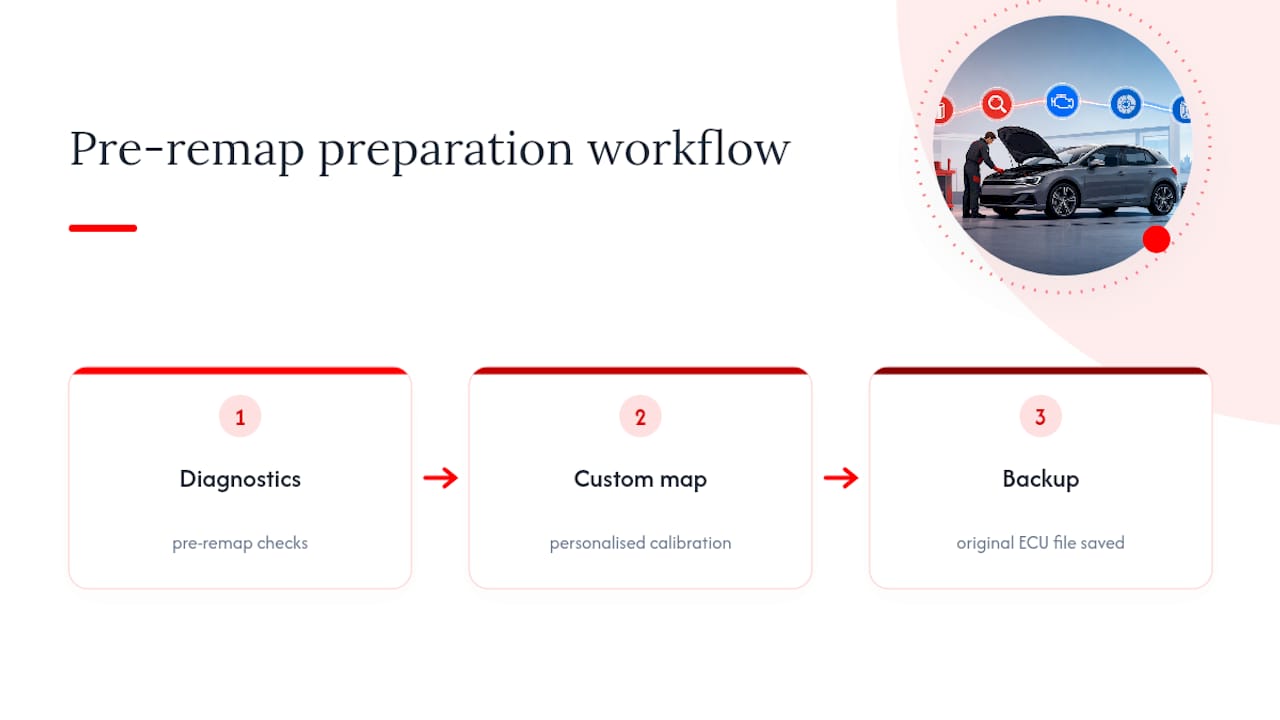
Some reputable tuners run pre-remap diagnostic checks and build personalised maps rather than loading generic files, backing up the original ECU file before any changes.
Whoever you choose, ask three things before you book: can they show you a datalog or dyno chart as proof of the result, will they hand over your original file if you ever need it restored, and what happens if a fault shows up after the work. A provider that answers all three without hesitation is one worth trusting with an older engine.
An honest view on chasing power in an ageing engine
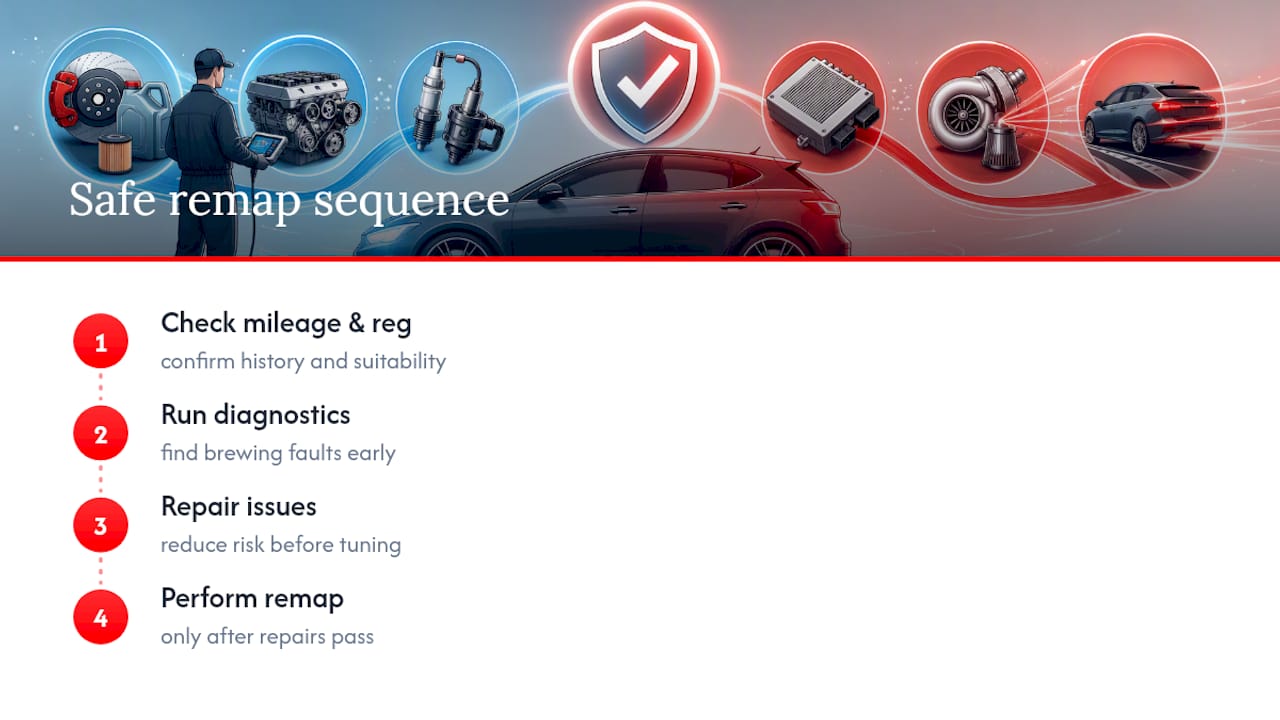
Most high-mileage cars can take a sensible remap. The ones that end up with problems are almost always cars where a fault was already brewing and the remap just made it obvious sooner. Honest diagnostics beat optimism every time, and repairs that reduce risk should always come before tuning that adds load.
If you’re weighing this up for your own car, get the mileage and registration checked properly before deciding either way. That single step tells you more than any forum thread ever will.
— Mark
Book a high mileage remap assessment with Performancetuningni
A quality tuning service typically begins with proper pre-diagnostic checks, offers a conservative Stage 1 option for older engines, backs up the original ECU file before any changes, and provides datalogs to demonstrate the results rather than only promising more power.
[
If your car has covered serious mileage, the sensible first step is finding out where it actually stands, not guessing from a magazine’s gain figures. The remap calculator gives you a registration-based assessment before you commit to anything, and the remapping service page covers Performance, Economy and Speed Limiter options in more detail. If a DPF or EGR issue is holding your engine back before you even get to tuning, the EGR and DPF solutions page is worth a look too. Book an assessment and get an honest answer on whether your car is ready.
Sources
FAQ
Is it safe to remap a high mileage car?
Yes, provided the engine passes a diagnostic scan and shows no turbo, injector or DPF faults beforehand. Condition matters far more than the mileage figure, and a conservative Stage 1 map reduces risk further on older engines.
Can insurers tell if a car has been remapped?
Insurers cannot detect a remap automatically, but a claim investigation can uncover one through a dealer diagnostic check or ECU file comparison. Any performance modification, remaps included, should be declared to your insurer to avoid a claim being reduced or refused later.
Will a Stage 2 remap fail an MOT?
An MOT tests emissions and safety systems, not power output, so a Stage 2 remap itself does not automatically cause a fail. It can fail if the tune pushes emissions beyond legal limits or disables equipment like the DPF, which is one reason a conservative approach suits most high-mileage cars better.
How can I make my car last 300,000 miles?
Consistent servicing, prompt attention to turbo, injector and DPF wear, and avoiding unnecessary load on components already showing wear are the main factors. A well-judged remap does not shorten that lifespan on a healthy engine, but skipping the pre-checks and tuning a car with existing faults will.
What does a remap cost, and does Performancetuningni offer one for high-mileage cars?
Performancetuningni’s Engine Remap is priced at £229 one-off, with the exact recommendation based on your vehicle’s registration and mileage. Every job includes pre-remap diagnostics and a conservative option for older, higher-mileage engines.
Recommended