
AdBlue system fault: what it means and what to do

When your dashboard shows an AdBlue system fault, the single most important step is to book a professional diagnostic scan using a manufacturer-level or SCR-capable tool. Do not top up the tank and hope for the best. Do not swap parts at random. The warning is not a fluid-level reminder; it is the ECU telling you something inside the SCR system is outside expected parameters.
What to do right now:
Book a specialist scan immediately, not a generic OBD reader that cannot communicate with SCR control modules.
You can usually drive short distances while you arrange the appointment, but avoid long trips if a countdown message has appeared.
If the display shows “engine starts remaining” or a mileage countdown, treat it as urgent. Under Euro 6 rules, the vehicle will eventually refuse to restart once the counter runs out.
Use ISO 22241-compliant fluid if you top up, but understand that topping up will not clear a logged system fault.
Performancetuningni offers professional SCR diagnostics, AdBlue removal, and engine remapping for exactly this situation.
Table of Contents
What does an AdBlue system fault actually mean?
A system fault is fundamentally different from a low-fluid reminder. The ECU has detected a condition outside normal operating parameters in the SCR (Selective Catalytic Reduction) system, and it has logged one or more fault codes as a result.
Here is how the system works in plain terms. AdBlue (a urea solution meeting ISO 22241) sits in a separate tank. A pump pressurises it and delivers it to a dosing injector, which sprays it into the exhaust upstream of the SCR catalyst. Upstream and downstream NOx sensors report to the ECU, confirming whether the catalyst is converting nitrogen oxides efficiently. If any link in that chain breaks, the ECU flags a fault.
The staged warning logic under Euro 6 is what catches most drivers off guard. A solid amber light is an early flag. A flashing light means the fault has escalated. A countdown message means the ECU has moved to enforcement mode. Topping up AdBlue will not clear a logged fault because the countdown is driven by fault codes and ECU validation cycles, not by tank level.
Common causes and the fault codes you may see
These codes are diagnostic flags describing conditions, not instructions to replace specific parts. A professional scan is always needed to confirm root cause.
Fault code | Plain-English meaning | Common cause |
P20EE | SCR catalyst efficiency below threshold | Degraded catalyst, NOx sensor drift, injector fault |
— | Reductant system performance | Pump pressure loss, injector blockage, crystallisation |
P20E8 | Reductant pressure too low | Air in lines after running tank dry, pump failure |
— | Reductant injector circuit faults | Injector failure, wiring fault, crystallised nozzle |
— | Reductant quality below threshold | Contaminated or incorrect AdBlue fluid |
— | Heater circuit faults | Heater element failure, common in cold weather |
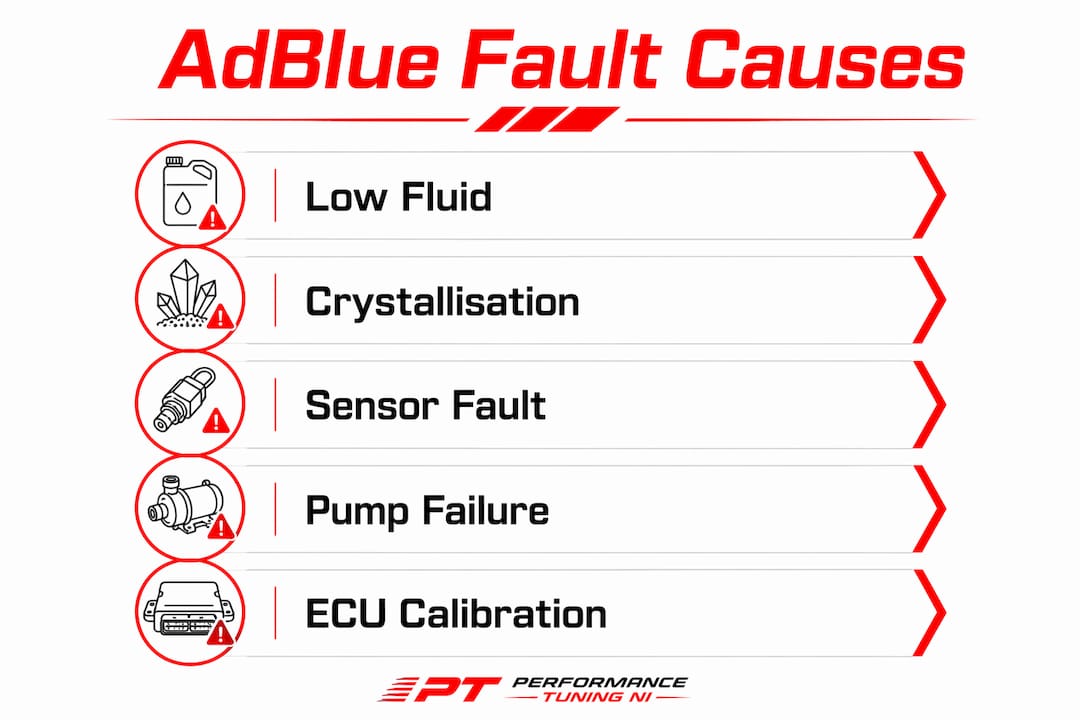
AdBlue crystallisation is one of the most frequently overlooked causes. When a vehicle sits unused or only does short trips, the water in the AdBlue solution evaporates and leaves solid urea deposits around the injector nozzle and pump lines. The result looks identical to a pump or injector failure on a basic scan. Similarly, heater faults are common after cold spells; AdBlue freezes at around −11°C, and a failed heater element triggers its own set of codes.
Generic OBD readers often cannot communicate fully with SCR control modules, which means they may miss pending codes or misrepresent the severity of the fault entirely.
What a proper professional diagnostic looks like
A professional diagnostic follows a fixed sequence: scan, live-data check, physical inspection, targeted repair, then a retest or adaptation drive. Skipping steps is how repeat faults happen.
Read all DTCs, including pending and historical codes, using a manufacturer-level or specialist SCR tool.
Capture live data: NOx sensor readings upstream and downstream, pump pressure, dosing status, and heater circuit state.
Physically inspect the dosing injector nozzle for crystalline deposits, check pump connections, and examine lines for damage.
Test heater and level sensors individually; a stuck level sensor can trigger a system fault even when the tank is full.
Check for air in lines if the tank was run dry before refilling; trapped air produces P20E8 pressure faults until the system is bled or electronically purged.
Perform an adaptation drive or forced re-check after any repair to confirm the ECU accepts the fix and clears the validation cycle.
Pro Tip: Repeatedly clearing fault codes without fixing the root cause accelerates the ECU’s escalation logic. The system needs live-data confirmation that the fault is genuinely gone, not just a code wipe.
Some vehicles also require 10–20 minutes of mixed driving after a refill before the ECU recognises the new fluid level. If the warning persists beyond that, a workshop-level diagnostic is needed, not another top-up.
Treatment options: cleaning, repair, ECU fixes, or AdBlue removal
Start with the least invasive option that the diagnostic evidence supports. Reserve AdBlue removal plus remap for specific, justified cases.

Option | When it applies | Likely outcome |
Tank drain and fluid replacement | Contaminated or incorrect AdBlue confirmed by scan | Resolves quality faults; straightforward if caught early |
Injector clean / decrystallisation | Crystallisation confirmed; injector otherwise intact | Good success rate; avoids replacement cost |
Pump, sensor, or heater replacement | Component confirmed failed by live-data evidence | Resolves fault long-term; cost depends on part |
Software recalibration / ECU remap | Calibration-based fault; hardware in good condition | Often more reliable than part swaps for software faults |
AdBlue removal + remap (delete) | Irreparable SCR hardware, off-road, export, or depot use | Permanent resolution; legal and warranty implications apply |
Cleaning procedures work well when crystallisation is the confirmed cause. A technician drains the tank, soaks and cleans the injector nozzle, and purges the lines. When the injector or pump has failed mechanically, cleaning will not be enough and targeted replacement is the right call.
Software-led repairs are often underestimated. Modern SCR systems are highly sensitive to ECU calibration state, and a recalibration can resolve faults that look like hardware failures on a surface scan.
Pro Tip: AdBlue removal and remap is a permanent solution, but it carries real legal and warranty consequences in the UK. Get professional advice before choosing deletion, and use it only where the vehicle’s use case genuinely justifies it.
UK legal, MOT, warranty and insurance considerations
Removing or altering emissions equipment has legal, warranty, and insurance consequences in the UK. Check DVSA and MOT rules, and your warranty and insurance terms, before proceeding with any deletion.
MOT failure: a vehicle with a non-functioning emissions system can fail its MOT on emissions grounds.
Warranty voiding: most manufacturer warranties are voided by ECU modifications or emissions-system deletions.
Insurance implications: failing to declare modifications can invalidate your cover; always notify your insurer in writing.
Roadworthiness and resale: a modified vehicle may face complications at point of sale or if involved in an insurance claim.
Road use restrictions: AdBlue deletion is legally appropriate for off-road, depot, or export vehicles. Using a deleted vehicle on public roads in the UK carries risk.
Check GOV.UK and DVSA guidance on vehicle modifications before booking any deletion service, and retain all diagnostic reports and service records whenever ECU work is carried out.
Typical costs and how long repairs take
Costs vary widely by root cause. Software recalibration is typically the least expensive fix; catalyst replacement sits at the other extreme.
Diagnostic scan: usually £50–£100 depending on tool depth and mobile vs. workshop visit.
Fluid drain and refill: relatively low cost; labour-light if caught early.
Injector clean: mid-range; same-day in most cases.
NOx sensor replacement: parts cost varies by vehicle; typically a half-day job.
Pump replacement: higher parts cost; may require ordering, adding a day or two.
AdBlue removal + remap: typically a one to two-hour appointment; mobile service available.
SCR catalyst replacement: the most expensive option; rarely the first recommendation.
Request an estimate that separates diagnostic time, parts, and labour. Same-day resolution is realistic for cleaning jobs and software fixes; pump or sensor replacements may need parts ordered first.
How to choose a specialist and what to ask
Choose a specialist who uses manufacturer-level or SCR-capable diagnostic tools and follows a scan, inspect, repair, retest workflow. That sequence is non-negotiable for a reliable fix.
Selection checklist:
SCR-capable diagnostic kit (not a generic OBD reader)
Live-data logging for NOx, pump pressure, and dosing status
Experience with Euro 6 diesel vehicles
Clear, itemised pricing for diagnostics versus parts
Mobile diagnostic option available
Written repair plan and service documentation provided
Questions to ask before booking:
Can you show me live NOx and pump pressure data from my vehicle?
Do you offer a no-start counter reset and a post-repair adaptation drive?
Will replacement parts be OEM or aftermarket, and what is the warranty on them?
What documentation will I receive after the work?
Red flags: any technician who recommends parts replacement without showing diagnostic evidence, uses only a basic code reader, or promises to “clear the light” without identifying the underlying fault. Replacing parts at random without a proper scan is the most common reason the same fault returns within weeks.
Key takeaways
An AdBlue system fault requires a specialist SCR diagnostic scan first; topping up fluid, clearing codes, or swapping parts without live-data evidence almost always leads to the fault returning.
Point | Details |
System fault ≠ low fluid | The ECU has logged a component or calibration fault; topping up will not clear it. |
Scan before any repair | Use a manufacturer-level or SCR-capable tool to read live NOx, pressure, and dosing data before touching parts. |
Crystallisation is common | Short trips and long storage cause urea deposits that block injectors; cleaning resolves this if caught early. |
Deletion has legal consequences | AdBlue removal is suited to off-road, depot, or export use; check MOT, warranty, and insurance terms first. |
Performancetuningni | Offers SCR diagnostics, AdBlue removal, and professional remapping with mobile and workshop options. |
Why a diagnostics-first approach is the right one
The temptation when a warning light appears is to act fast, swap the obvious part, and move on. That instinct costs money. The vehicles that come back with the same fault a fortnight later are almost always the ones where codes were cleared without a live-data check confirming the root cause.
Performancetuningni has tuned thousands of vehicles and holds a five-star Google rating, built on a straightforward principle: accurate diagnosis first, targeted fix second. For fleet operators, off-road users, or owners facing irreparable SCR hardware, AdBlue removal and remap is a pragmatic outcome, not a shortcut. But it is recommended only after a proper diagnostic confirms there is no cost-effective repair path. That distinction is what separates a lasting fix from a recurring bill.
Performancetuningni: professional diagnostics, AdBlue removal, and remapping
Performancetuningni delivers faster, clearer resolution of AdBlue faults than a main dealer, without the waiting list or the four-figure estimate before anyone has looked at the car.
The service covers SCR diagnostics with live-data reporting, fault-code interpretation, AdBlue removal for appropriate use cases, and professional engine remapping for performance and economy gains. Mobile and workshop appointments are both available, and most diagnostic visits are completed on-site. Trust signals speak for themselves: thousands of tuned vehicles and a five-star Google rating across the board.
Use the free remap calculator to see what your vehicle stands to gain, or get in touch directly to book a diagnostic appointment and receive a clear, itemised quote before any work begins.
Useful sources and further reading
Authoritative sources on AdBlue chemistry, fault codes, and SCR system behaviour include specialist repair guides and the ISO 22241 standard for AdBlue quality.
iFix AdBlue: AdBlue system malfunction warning explained — detailed breakdown of fault types and escalation logic.
Repair My AdBlue: AdBlue system fault no-restart warning — causes and fix options for countdown scenarios.
AdBlue Specialist: light patterns, flashing and countdown explained — practical guide to interpreting dashboard warnings.
iFix AdBlue: fault codes master list — reference list of common SCR fault codes and their meanings.
GOV.UK / DVSA: check current MOT standards and vehicle modification rules before proceeding with any emissions-system alteration.
When discussing warranty or insurance implications with your insurer or dealer, bring printed copies of your diagnostic report and any fault-code history. It makes the conversation considerably shorter.
Recommended