
Remap First, Replace Last: Fix Turbo Lag for Northern Ireland Cars
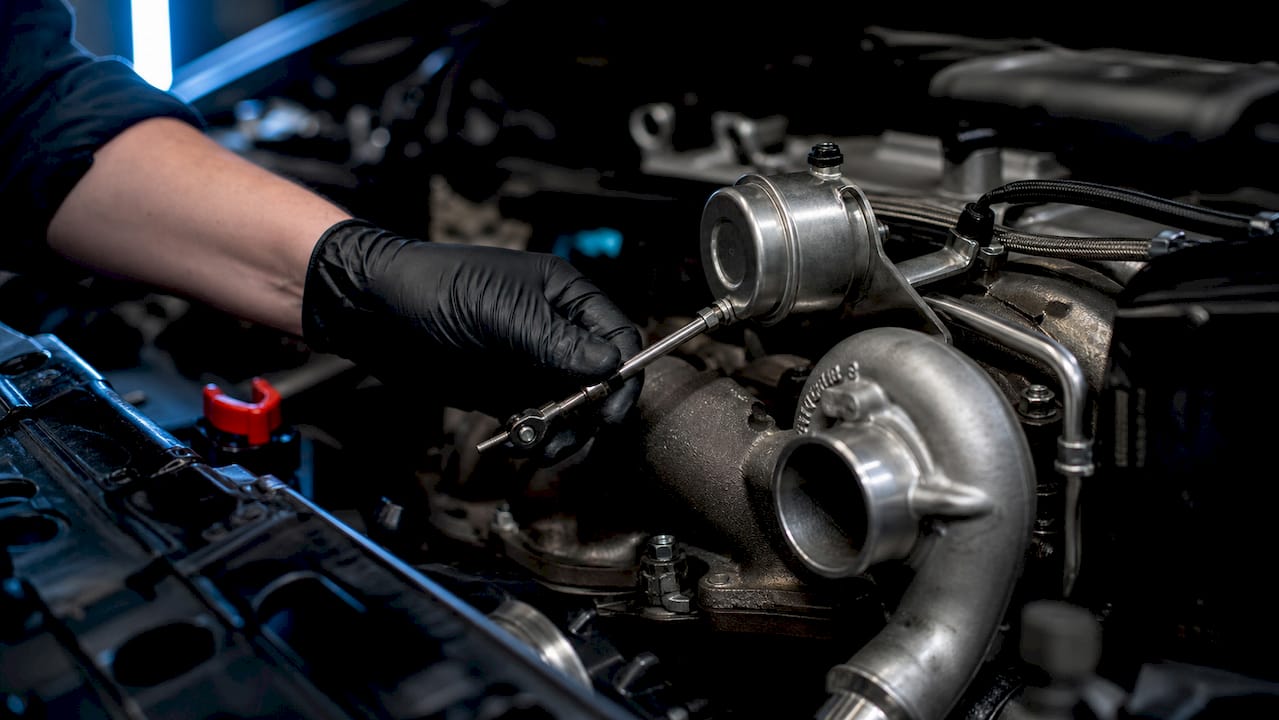
Turbo lag is almost always reducible and rarely eliminable, and the biggest gains for road cars come from correct diagnosis, routine maintenance and ECU calibration, in that order. Hardware swaps sit last on the list, not first, because most “lagging” turbos are actually suffering leaks, sticky actuators or a fuel map that doesn’t match the hardware. Performance Tuning NI treats this as a diagnostic job before it’s ever a parts-buying job, and that sequence is what separates a fix that lasts from one that just moves the problem.
TL;DR:
Most cases of turbo lag stem from leaks, sticky actuators, or calibration issues, not the turbo hardware itself, and should be diagnosed accordingly.
Properly diagnosing boost leaks involves visual inspection, pressure and smoke testing, and checking actuator and vane movement before considering hardware upgrades.
Routine maintenance like oil changes, air filter replacement, and intercooler cleaning can significantly reduce lag without expensive parts swaps.
ECU remapping offers the most cost-effective improvement by optimizing fuel, ignition, and boost control, provided leaks and maintenance are addressed first.
Hardware upgrades such as twin-scroll or VGT turbos only improve response when combined with correct calibration and proper diagnostics.
Table of Contents
What causes turbo lag and why it can’t be fully removed
Turbo lag is the gap between pressing the throttle and feeling boost arrive. On most modern turbo petrol engines that’s under a second; on larger diesel units, particularly older ones without variable geometry, it can stretch to two seconds or more under load.
The delay exists because a turbocharger only spins as fast as the exhaust gas driving it. At low revs there isn’t enough exhaust energy to spin the turbine quickly, so the compressor side can’t force enough air in to build boost. Some turbochargers spin at speeds approaching 300,000 rpm under load, and getting a stationary rotating assembly from idle to that speed takes a measurable amount of time and energy, no matter how well the engine is maintained.
Several factors decide how bad that gap feels behind the wheel:
Turbo sizing: a larger turbo shifts more air at high revs but takes longer to spool, while a smaller unit spools fast but runs out of puff sooner.
Turbine and compressor matching: a mismatched pairing wastes exhaust energy or chokes airflow, worsening lag either way.
Drivetrain factors: a torque converter that slips before lock-up, or gearing that keeps revs low in the boost-building zone, exaggerates how sluggish the response feels even when the turbo itself is behaving normally.
Fuel type: diesel engines rely on larger turbos and lower rev ceilings to make torque, so they typically show more low-end lag than petrol engines, which spin faster and build exhaust energy more quickly.
None of this means lag is fixed. It means the achievable target is a shorter, smoother delay, not an instant one.
Is it really turbo lag, or something else?
Plenty of drivers chase a “turbo lag fix” for a problem that has nothing to do with the turbo’s inertia at all. A soft pedal, a delayed surge, or boost that builds then dips are classic symptoms of boost leaks, exhaust leaks ahead of the turbine, a clogged air filter, or a collapsing intake boot, and these should be ruled out before anyone talks about remapping or new hardware.
A sensible diagnostic order looks like this:
Visual inspection: check every intake hose, boost pipe and clamp for cracks, splits, or a loose jubilee clip.
Boost or pressure test: pressurise the intake tract with a hand pump and watch the gauge for drop-off, which points straight to a leak.
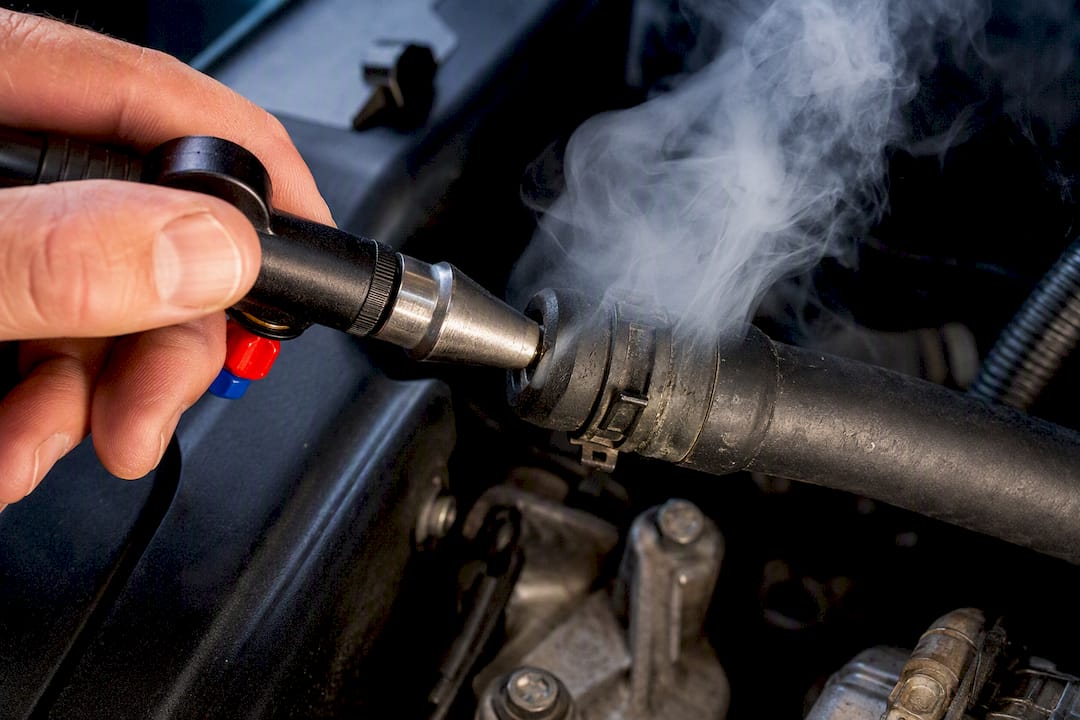
Smoke test on the intake/boost tract: pump smoke into the system and look for it escaping anywhere between the filter and the intake manifold, a method that reliably exposes leaks masquerading as lag.
VGT vane check: on variable geometry turbos, check vane movement manually or with diagnostic software, since carbon buildup is a common cause of sticky, slow actuation.
Wastegate actuator check: inspect the vacuum or electronic actuator for correct movement and no sponginess in the linkage.
Boost build logging: use a data logger to record boost rise against RPM and compare it to a known-healthy baseline for the same engine.
Each test gives a clear pass or fail. A leak test that holds pressure and a clean smoke test point the problem away from the turbo and towards the ECU calibration or the turbo’s own internals.
Pro Tip: Run the smoke test before you touch anything else. A £20 leak is often mistaken for a £2,000 turbo problem, and ruling it out first saves you from paying for parts you didn’t need.
Once leaks, filters and actuators check out clean, that’s the point to stop DIY testing and bring in a proper diagnostic setup with live data logging, because you’re now looking at calibration or a genuine hardware fault.
The right order for fixing turbo lag: maintenance, software, hardware
Fixing turbo lag properly means working through three tiers, cheapest and most effective first.
Maintenance fixes cost the least and often solve more than owners expect:
Fresh oil to the manufacturer’s specified viscosity, since thickened or degraded oil slows turbo bearing spin-up.
A clean air filter, because restricted intake airflow starves the turbo of the air it needs to build boost efficiently.
A cleaned intercooler and core, since a clogged intercooler adds pressure drop across the whole boost circuit.
Replaced hoses and clamps wherever the leak test found weakness.
A check of manifold and turbo gaskets for exhaust leaks that rob the turbine of driving energy.
Software and ECU calibration is where the biggest everyday improvement usually happens. A calibrated remap adjusts transient fuelling so the engine doesn’t hesitate on initial throttle input, sharpens throttle mapping for a quicker pedal-to-response feel, and refines wastegate duty cycle or VGT vane control so boost builds sooner and holds more precisely. On engines with predictive boost strategies, the ECU can even pre-empt driver demand rather than simply reacting to it. This is consistently the highest-return step because ECU calibration coordinates fuelling, timing and boost control to match the hardware already fitted, rather than throwing new parts at a system that was never tuned to use them properly.
Hardware upgrades come last, and only once maintenance and calibration have been exhausted:
Hardware option | What it does | Trade-off |
Twin-scroll turbo | Separates exhaust pulses to spin the turbine more efficiently at low revs | Higher cost, needs a matching exhaust manifold |
Variable geometry (VGT) | Adjusts vane angle to suit both low and high RPM | Complex, and only works with correct calibration |
Ball-bearing centre section | Reduces rotational friction versus journal bearings | Meaningful but modest gain, moderate cost |
Electrically assisted (e-turbo) | Uses an electric motor to spin the turbine before exhaust energy takes over | Effective but heavily software-dependent and expensive to retrofit |
Anti-lag systems and nitrous oxide can cut spool time dramatically, but they’re built for competition, not commuting. Both place severe thermal stress on turbo and exhaust components and carry reliability and legality problems on public roads, so they don’t belong anywhere near a road-legal turbo lag fix.
When to book a remap: what a proper tuner should show you
Remapping changes four things that directly govern how lag feels: ignition timing, fuel delivery, wastegate or vane control, and the throttle map that translates pedal position into engine response. Get those four right and the same turbo hardware spools sooner and delivers power more smoothly, without a single new part fitted.
That’s why remapping is usually the better first paid step over hardware swaps for a daily-driven car. New turbos or manifolds are expensive and can actually blunt low-end response if the accompanying software isn’t recalibrated to suit, an issue experts at Engine Builder Magazine have flagged repeatedly when hardware-heavy fixes go wrong on road cars.
Before booking any tuner, ask for:
Boost-build logs from before and after the calibration, since comparing boost rise against a baseline is the standard proof of a genuine improvement.
Road or dyno results showing the actual change, not just a promise of “more power”.
A clear warranty position on the work carried out.
Pro Tip: Ask what the tuner changed in the transient fuelling map specifically. If they can’t explain it, they probably haven’t touched it, and your throttle response won’t improve much either.
Performance Tuning NI backs this process with thousands of vehicles tuned and a five-star Google rating, offering both onsite and mobile remapping so the diagnostic and calibration work happens without the car sitting in a queue. Full detail on what a remap actually changes under the bonnet is covered in this breakdown of ECU remapping benefits.
Your turbo lag action plan
Start today, in this order:
Check every visible hose, boot and clamp for cracks or looseness.
Replace the air filter if it’s dirty and check the intercooler for blockages.
Run a basic pressurise-and-hold test on the boost tract if you have the kit.
If the lag persists after that, capture a boost-build log and book a proper diagnostic or remap, giving the tuner your symptoms, mileage and any fault codes.
Expect a calibrated remap to sharpen throttle response and shorten the boost-build window; expect hardware changes only if diagnostics show the turbo itself, not the calibration, is the limiting factor.
Why the hardware-first instinct gets this backwards
Most owners chasing a turbo lag fix start by pricing turbos, when the data points the other way. The Engine Builder Magazine research on misdiagnosed lag and the Reynlab findings on calibration gains both land on the same conclusion: the software running the existing hardware is usually the weak link, not the hardware itself.
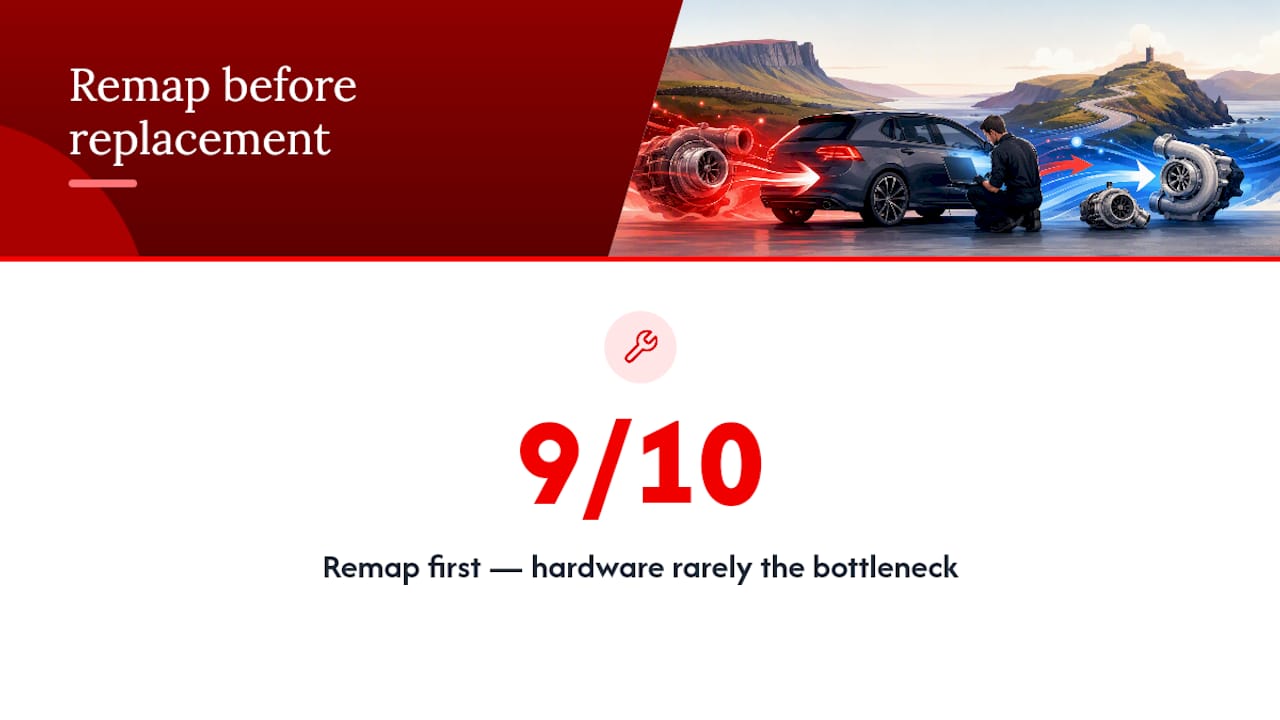
The conventional advice, “get a bigger turbo,” ignores that a bigger turbo without a matching calibration can make low-end response worse, not better. That’s the part enthusiast forums consistently underplay. A twin-scroll housing or a ball-bearing centre section only pays off once the ECU is telling it what to do, and that’s a calibration job first.
My take: if you’ve not run a leak test and you’ve not had the ECU properly calibrated for the hardware you already own, you haven’t earned the right to blame the turbo yet. Fix the cheap stuff, calibrate the software, and only then decide whether hardware is genuinely the bottleneck. Nine times out of ten it isn’t.
— Mark
Get your turbo response sorted properly
If you’ve worked through the leak checks and maintenance and the hesitation is still there, a calibrated remap is the next sensible step, and it’s exactly what Performance Tuning NI does every day. Rather than sending your car to a generic garage and hoping someone understands transient fuelling maps, you get tuning built specifically around your engine’s hardware, with onsite or mobile appointments so you’re not losing a day to it.
[
Performance Tuning NI has calibrated thousands of petrol and diesel vehicles across a five-star-rated service, refining throttle mapping, boost control and fuelling to sharpen response without touching a single turbo component. Not sure whether your car is a good candidate? Run your registration through the free remap calculator for an instant estimate, or head straight to the engine remapping and ECU tuning service to book a diagnostic and calibration session. If carbon buildup around the intake or VGT vanes is part of the picture, the carbon cleaning service tackles that directly rather than leaving it to clog your fix from the inside.
Sources
Recommended