
Towing remap: what it actually changes and what it won't

A towing remap can safely sharpen low- and mid-range torque and make towing noticeably easier. It works by recalibrating fuelling, boost, and torque delivery in the band you actually use when hauling a trailer, not by chasing headline horsepower. What it won’t do is change your vehicle’s legal tow rating, which stays fixed by the manufacturer’s chassis, brake, and transmission specifications. Before you book anything, get a pre-tune health check and tell your insurer about the modification.
Torque improves in the 1,500 to 2,500 rpm range where towing strain actually happens
Legal tow capacity is unaffected, whatever the map says
TL;DR:
Towing remaps mainly enhance torque between 1,500 and 2,500 rpm to reduce strain during actual hauling, not increase peak horsepower.
The vehicle’s legal towing capacity remains fixed by chassis, brake, and transmission limits, regardless of ECU tuning.
A thorough pre-tune health check of the DPF, injector performance, turbo, transmission, and cooling is essential to avoid drivetrain stress.
Owners must inform their insurance companies and obtain written confirmation to avoid future claim issues after a remap.
Bespoke calibration from experienced tuners includes diagnostics, original file backup, and post-tune verification for safe and effective towing performance.
Table of Contents
What a towing remap changes in the ECU
A remap for towing is not the same file as a remap chasing peak bhp for track days. The calibration targets sit in different places entirely.
Torque shaping between 1,500 and 2,500 rpm. This is the band where a loaded vehicle actually works, pulling away from a junction or climbing a motorway incline with a trailer behind it. Tuning written specifically for towing prioritises steady output here over a dramatic top-end number nobody uses while hitched up.
Boost curve adjustments. A towing map aims for earlier turbo spool and a steadier boost plateau under sustained load, rather than a peaky rush that spikes and falls away.
Fuelling and air-fuel ratio control. Sustained pulling generates more heat than a quick sprint, so the calibration has to manage exhaust gas temperatures carefully rather than lean the mixture out for a quick power gain.
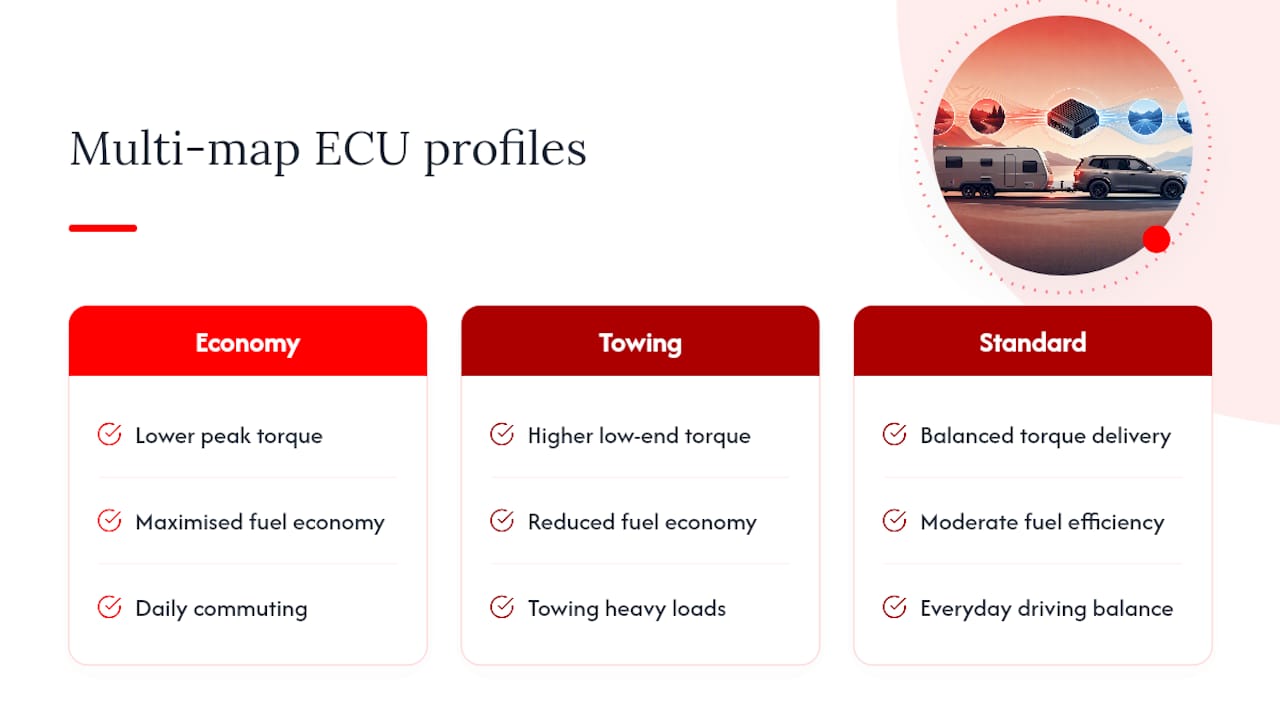
Limiter and multi-map flexibility. Some setups allow switching between economy, towing, and standard maps, which matters if you only tow occasionally and want your daily drivability untouched the rest of the time.
The theme running through all four is that mid-range usability beats peak bhp when there’s a caravan or horsebox on the back.
Which vehicles see the biggest towing gains?
Not every vehicle responds the same way, and it’s worth knowing where you sit before you spend money.
Diesel 4x4s and pickups typically show the clearest gains, since their engines are already built around low-rpm torque and a remap simply refines what’s there.
Medium panel vans and turbo petrol tow cars also respond well, particularly where the factory tune has been left conservative for emissions headroom.
Occasional light towing, a small trailer a few times a year, will feel a noticeable but modest improvement in responsiveness.
Frequent heavy towing, caravans, horseboxes, or plant trailers, is where the difference is most obvious, because that’s when low-end strain is constant rather than occasional.
Naturally aspirated petrol engines with little factory reserve will see only modest gains, since there’s less latent capacity to unlock.
Safety checks a reputable remapper should never skip
A remap changes how the engine behaves, not what the vehicle is rated to tow. Chassis strength, braking capacity, and transmission specification set the legal limit, and no ECU file alters that. Remapping does not increase a manufacturer’s tow rating, full stop.
What a remap can do is stress the drivetrain harder if it’s not checked first. That’s why a proper health check comes before any tuning, not after:
DPF and EGR condition, since a failing system won’t cope well with extra load
Injector performance and turbo condition, both of which affect how safely extra torque can be delivered
Cooling capacity, since a transmission cooler is worth considering for anyone towing heavy loads regularly
Owners who tow often should also weigh up supporting hardware such as transmission coolers and catch cans to protect the drivetrain and intake under sustained strain, and a diesel intercooler upgrade can help keep charge temperatures in check on long, hard pulls.
What torque and economy gains actually look like
Indicative mid-range torque uplifts for a well-specified diesel towing map tend to sit in a range that translates into fewer downshifts on hills and a noticeably calmer overtake with a trailer attached, rather than a dramatic top-speed change. A correctly specified towing remap can reduce engine labour under load, and that reduced strain sometimes shows up as better towing fuel economy than the same vehicle running stock under identical conditions, largely because the engine holds a higher gear more comfortably instead of hunting through the box.
Towing always uses more fuel than driving unladen. A remap doesn’t erase that, it just makes the extra effort less punishing. Results vary with trailer weight, turbo type, vehicle condition, and how the driver actually uses the extra torque.
Cost, booking, and mobile versus workshop remaps
Price depends mainly on whether you need a bespoke map built for your exact vehicle and towing pattern or a generic file, plus whether TCU work and full diagnostics are included. Complexity adds cost, but it’s the difference between a tune that suits your trailer and one that’s a rough approximation.
Mobile remapping suits owners who want convenience, the tuner comes to you, and it works well for straightforward jobs.
A proper service should always include a pre-tune health check, a backed-up original ECU file so the car can be restored, post-tune verification, and written notes on what was changed.
Skip any of those four and you’re not getting a professional job, whatever the price.
Choosing a remapper: questions to ask and red flags to avoid
Getting this right matters more than shaving a few pounds off the price. Ask these before you book:
Have you tuned this specific make and model for towing before, and can you show real examples?
Do you run full diagnostics before and after?
Is my original file backed up, and can you roll back to it if I’m not satisfied?
What evidence will I get that the tune actually worked?
Red flags are just as telling. Walk away from anyone promising unrealistic bhp figures, refusing a health check, or unable to confirm they keep a backup of your original file. No post-tune verification means no proof the job was done properly.
Two administrative steps matter as much as the mechanical ones. Owners are required to disclose ECU remaps to their insurer, and it’s worth getting written acknowledgement that they’ve noted it on the policy. On MOT, a compliant remap that leaves emissions systems intact and functioning shouldn’t cause a failure, though it’s the retained systems that matter, not the map itself.
Remap versus other towing upgrades: what actually helps
A remap sits alongside other options, not above them, and the right answer often involves more than one.
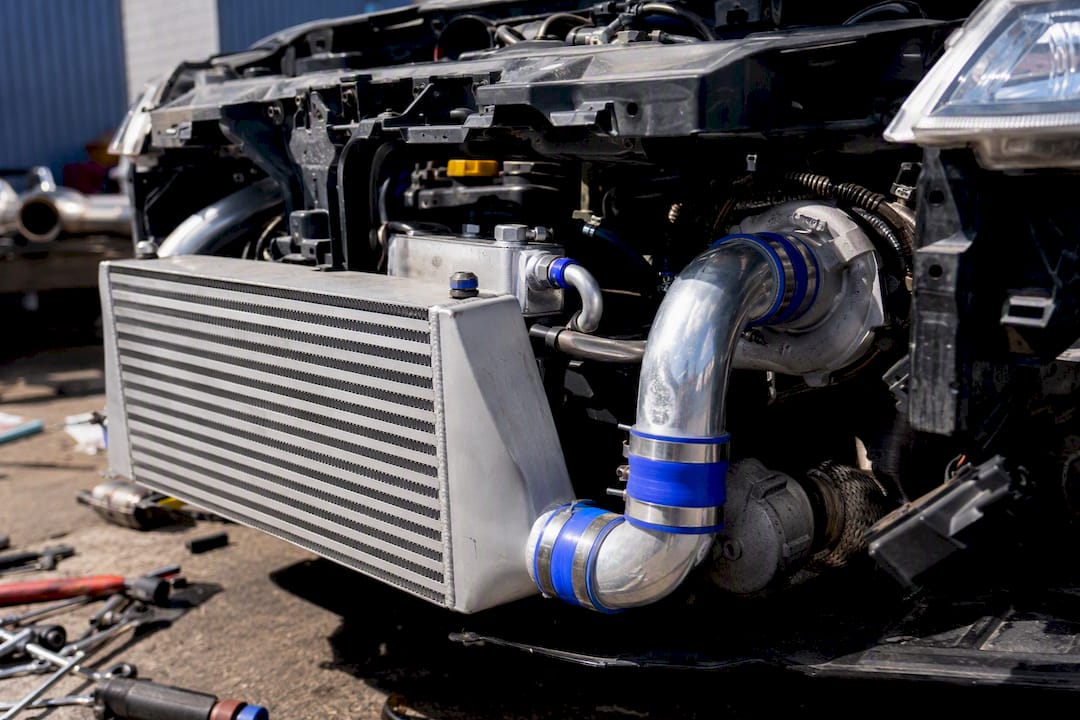
Hardware upgrades like a bigger intercooler, uprated turbo, or exhaust changes can support higher output, but they cost more and usually need a matching recalibration to be worth doing at all. Fitting hardware without adjusting the ECU to use it properly is money spent for very little gain. A remap alone, done to a towing-focused specification, is often the more cost-effective first step because it works with the engine’s existing hardware rather than replacing it.
Braked trailers are a different category of upgrade entirely, since they affect how the whole combination stops rather than how it pulls. A braked trailer improves stability and stopping distance regardless of what the tow vehicle’s engine is doing, and it’s not optional above certain trailer weights under UK towing law. It doesn’t substitute for a remap, and a remap doesn’t substitute for it.
Multi-map setups offer a middle path worth knowing about. Switching between economy, towing, and standard calibrations means you’re not stuck with a towing-biased map on your daily commute, which matters if the vehicle does double duty. For most owners weighing up where to spend first, a well-specified remap paired with a genuine pre-tune check delivers the clearest return before hardware changes are even considered.
The overlooked trade-off in towing remaps
Most advice on this topic still chases bhp numbers, which is the wrong instinct for anyone actually towing. Peak power figures come from parts of the rev range you rarely use with a loaded trailer behind you. What matters is what happens between 1,500 and 2,500 rpm, and whether the transmission and cooling system can live with it long term.
The conventional pitch, “we’ll add X bhp,” misses the point of what makes towing safer and more comfortable. A tuner who talks about torque delivery, exhaust gas temperatures, and transmission readiness before mentioning a headline figure is the one worth trusting. That’s also why post-tune verification matters more than the marketing copy: a map that hasn’t been checked for fault codes and boost stability after the fact is a promise, not a result.
If you tow often, prioritise the health check and the TCU conversation before you even discuss numbers. The engine work is often the easy part.
— Mark
Book a towing remap with Performance Tuning NI
Performance Tuning NI builds bespoke towing calibrations rather than pulling a generic file off a shelf, and every remap starts with a proper diagnostic, not a guess.
[
A towing remap here includes a pre-tune health check, a mid-range calibration built around your engine and towing pattern, a backed-up original ECU file so nothing is left to chance, and post-tune checks to confirm the work has done what it should. That approach comes from tuning thousands of cars across petrol and diesel, backed by a five-star Google rating, with both mobile and workshop appointments available depending on what suits you. The full remapping service covers the diagnostic-first approach described throughout this guide, and if you’re also noticing sluggish response alongside towing strain, pairing a remap with carbon cleaning can help you get the result you’re expecting. Start by entering your registration into the free remap calculator for an instant estimate, or get in touch to book a diagnostic and quote.
Key Takeaways
A towing remap improves low- and mid-range torque and drivability without ever changing a vehicle’s legal tow rating, and it must always be paired with a pre-tune health check and insurer disclosure.
Point | Details |
Torque band matters most | Gains between 1,500 and 2,500 rpm are what actually ease towing strain, not peak bhp. |
Legal tow rating unchanged | Chassis, brakes, and transmission specification set the limit, whatever the remap does. |
Health check comes first | DPF, EGR, injectors, turbo, and transmission condition all need checking before tuning. |
Insurance disclosure required | Tell your insurer about the remap and get written acknowledgement on the policy. |
Performance Tuning NI approach | Bespoke towing calibration with pre-tune diagnostics, original file backup, and post-tune verification. |
Sources
Recommended