
Does remapping harm your engine's reliability?

A properly executed Stage 1 remap on a mechanically healthy car wont reduce reliability. What actually damages engines is a poor-quality map, an overly aggressive file, or tuning a car that already has a fault. Reputable tuners run diagnostic scans before touching the ECU and verify the finished map, which is where remap reliability is genuinely won or lost. Performance Tuning NI builds every remap around that principle. If you want the practical checklist for minimising risk, skip to how to reduce reliability risks below.
Verdict: conservative, bespoke Stage 1 maps rarely shorten engine life
Risk driver: poor diagnostics, generic files, or tuning a faulty engine
Proof points: pre-remap scans, verification, datalogging
Key Takeaways
Remap reliability depends far more on diagnostic discipline and map quality than on the decision to remap itself.
Point | Details |
Diagnostics come first | A full OBD scan and mechanical check before remapping catches faults a tune would only expose faster. |
Conservative maps preserve margins | Stage 1 tunes that keep EGT monitoring and knock protection rarely shorten engine life on a healthy car. |
Watch the driveline, not just the engine | Turbos, clutches and DSG gearboxes carry the extra load and show problems first. |
Disclose to your insurer | Non-disclosure of a remap can invalidate cover regardless of whether the car was later rolled back. |
Performancetuningni builds in verification | Bespoke, dyno-tested remaps with pre-checks and datalogging are the practical way to protect reliability. |
Table of Contents
What checks a reputable tuner runs before a remap
Is remapping safe for your specific car? That depends almost entirely on what happens before the laptop connects to the ECU. A tuner who skips diagnostics is gambling with your engine, not tuning it.
A proper pre-remap health check covers:
A full OBD fault code scan to rule out existing faults the ECU is already flagging.
Oil and coolant inspection, checking condition and levels rather than just topping up.
A visual check for leaks around vacuum lines, intercooler pipework and turbo seals.
A remap acts as a catalyst. It doesn’t create a worn turbo seal or a marginal injector, but it will expose one faster than gentle driving ever would. Any fault found here should be repaired first, not tuned around.
Pro Tip: If a tuner offers to remap your car without running a scan first, walk away. That single scan is the cheapest reliability insurance you’ll ever buy.
How remaps change engine load and affect component wear
Remapping alters four core parameters: torque output, boost pressure, fuelling and ignition timing. Each one shifts how hard the engine works, and each carries its own mechanical consequence if pushed too far.
More torque means more force through the clutch, gearbox and driveshafts. More boost raises cylinder pressure and heat. Richer fuelling changes combustion temperature, and advanced timing brings the engine closer to knock, the metal-on-metal shockwave that can crack pistons if left unchecked.
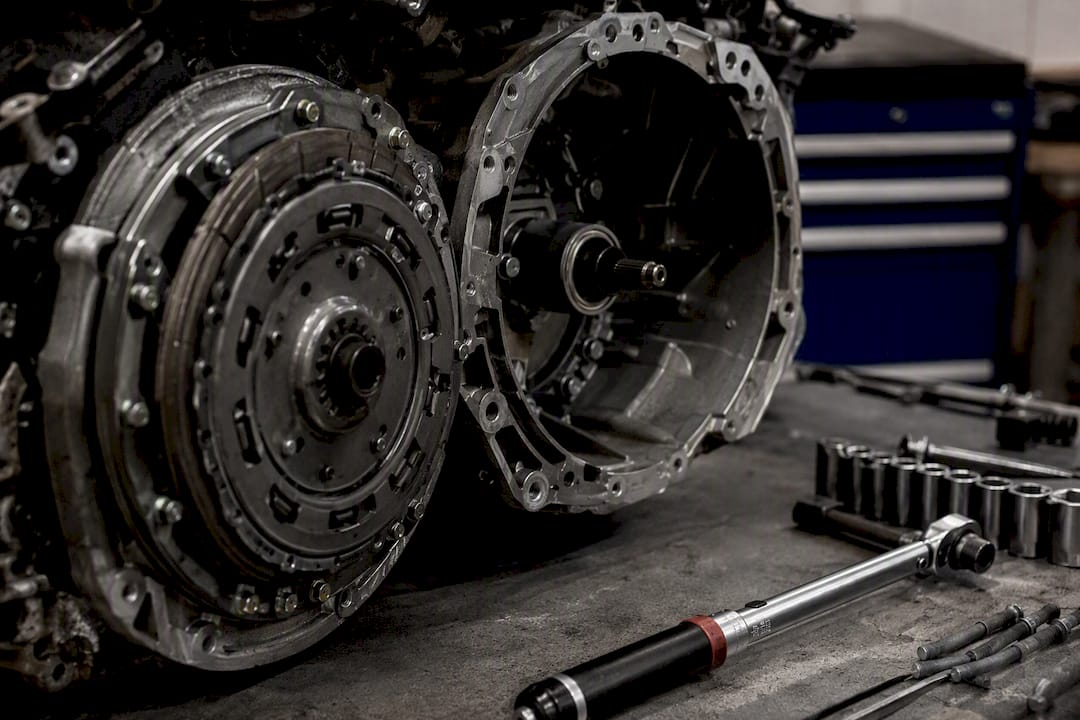
A conservative Stage 1 remap typically works within the factory hardware’s margins, adding power without asking the turbo or clutch to do something they weren’t built for. Aggressive or generic “off-the-shelf” files behave differently: they often chase bigger numbers by trimming the safety margin the manufacturer built in, which is exactly the mechanism technical reviews point to when explaining raised thermal and mechanical stress after tuning.
A well-built map keeps the protections that matter:
Exhaust gas temperature (EGT) monitoring to pull back fuelling before things overheat
Knock detection that retards timing the instant it senses pre-ignition
Torque limiters that respect what the clutch and gearbox can actually handle
Professional guidance is consistent on this point: a remap developed with those protections intact, on a healthy engine, does not typically compromise reliability.
Which parts are most likely to fail after a remap
The components under the most additional load are the ones to watch. None of this is inevitable. It’s a map of where neglect and aggressive tuning tend to show up first.
Turbocharger: whining, excess smoke, or a loss of boost pressure under load.
Clutch and DSG/automatic gearboxes: slipping, shuddering, or delayed gear engagement.
Manual gearbox internals: grinding or difficulty selecting gears under higher torque.
Cooling system: rising coolant temperature or the fan running constantly.
Injectors: misfires, rough idle, or a noticeable drop in economy.
Oil system: rising consumption or, in serious cases, sudden oil loss.
Rising EGTs and misfires are usually the earliest warnings, well before anything fails outright. Driving style amplifies all of this. Repeated hard launches on a car with an already-tired clutch, or towing on a remap never designed for it, will find the weak point faster than the remap itself ever would. Skipped oil changes make everything worse, since a hotter-running engine is less forgiving of degraded lubrication.
How to reduce reliability risks: choosing a tuner and map
Remap reliability comes down to two decisions: who tunes the car, and what kind of map they write. Get both right and the risk drops sharply.
Favour a bespoke map over a generic file every time. Ask the tuner these questions before you book:
What diagnostics do you run before remapping?
Which factory protections (EGT limits, knock control, torque limiters) does the map retain?
What’s your rollback policy?
Reliability doesn’t stop at the appointment. Expect to move to a higher-grade oil if recommended, tighten up service intervals slightly, and if you’re driving a DSG or automatic, factor in more frequent gearbox fluid changes. These small maintenance shifts are what keep a well-tuned engine running well for years, not just months.
What happens on the day: timeline, verification and cost
A professional remap appointment generally runs in three stages: diagnostic scan, map application, and verification to confirm everything behaves as expected.
Most appointments take between one and three hours. Longer sessions usually mean the tuner is developing a fully bespoke map rather than loading a pre-built file, or additional repairs came up during the diagnostic stage.
Costs vary with the same logic. Bespoke dyno tuning costs more than a generic file because it’s built and verified for your specific car, and any supporting hardware or repairs identified beforehand add to the bill. That’s money spent protecting reliability, not chasing numbers.
Why you can trust this advice
Performance TuningNI specialises in custom engine remapping for petrol and diesel engines, built around the diagnostic and verification discipline covered throughout this guide.
Thousands of vehicles tuned, backed by a five-star Google rating
Customers consistently report smoother power delivery and sharper throttle response after a properly matched remap
Every map is developed with the vehicle’s actual condition in mind, not a generic template
Practical experience shows that well-maintained, conservatively tuned vehicles can rack up serious mileage without reliability complaints
That combination, diagnostics first, bespoke calibration second, is the same approach behind every recommendation in this article.
What long-term studies say about remapped engines
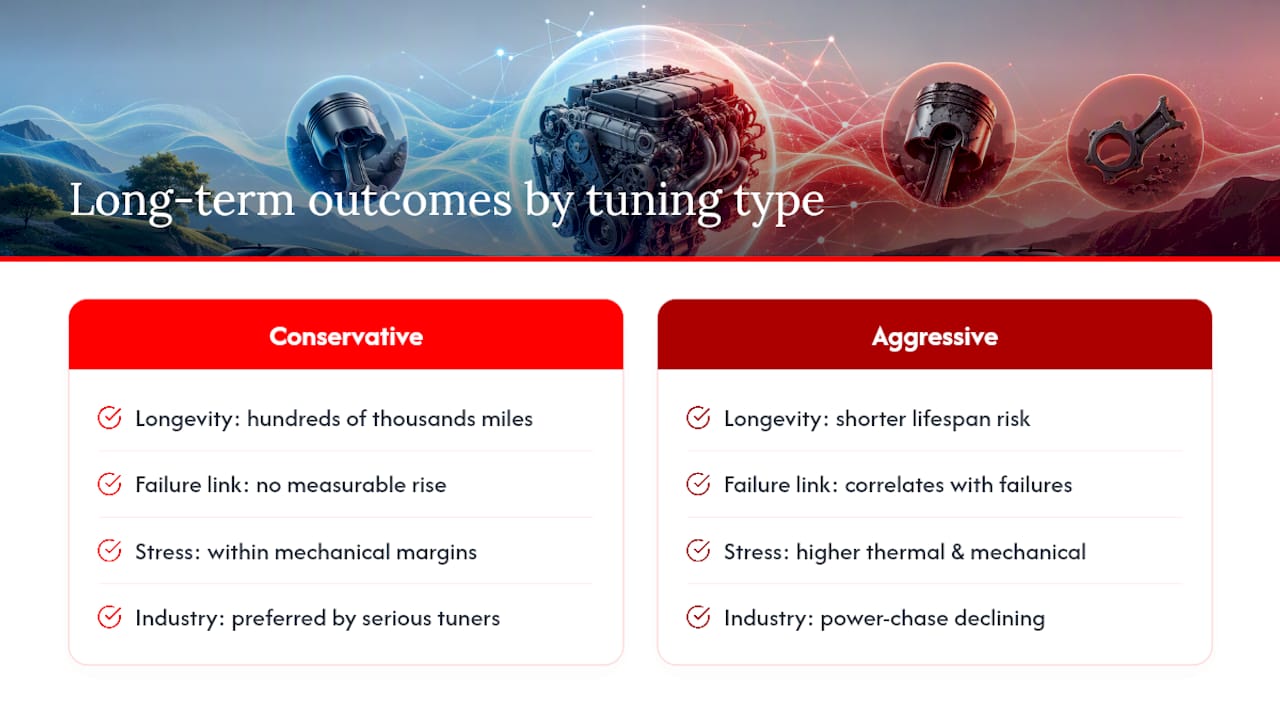
Long-term data on remapped engines is thinner than owners would like, but the pattern that does exist is consistent. Industry reports and case examples show that vehicles with conservative, well-matched maps and proper maintenance can cover hundreds of thousands of miles without the remap itself becoming the point of failure, according to practical field reporting from within the tuning industry.
Academic reviews add a more cautious layer. Technical analysis of remapping and ECU tuning finds that reliability outcomes split sharply along the line between conservative and aggressive tuning: cars run within the manufacturer’s mechanical margins tend to show no measurable increase in failure rates, while aggressively pushed files correlate with higher thermal and mechanical stress over time.
The honest summary is that there’s no large-scale, controlled study following thousands of remapped cars for a decade. What exists instead is converging evidence from tuning specialists, case reporting and mechanical engineering analysis, all pointing the same direction: the map’s quality and the car’s starting condition matter more than the remap category itself.
That’s also why the industry has started treating emissions compliance as part of the reliability conversation, not a separate issue. Tightening regulatory frameworks are narrowing what aftermarket calibration can safely do, which pushes serious tuners toward more conservative, emissions-aware maps rather than the flat-out power chase that dominated tuning a decade ago.
Does reliability risk differ by make and model?
Remap reliability isn’t uniform across manufacturers, because the factory-fitted hardware sets the ceiling for how much margin a tuner has to work with. A diesel with a robust, over-engineered turbo and gearbox tolerates a Stage 1 remap very differently to a small turbocharged petrol running close to its thermal limits from the factory.
German diesels with cast-iron blocks and heavy-duty injection systems have earned a reputation for shrugging off moderate remaps, largely because manufacturers built substantial mechanical headroom into those platforms. Smaller three-cylinder turbo petrols, increasingly common across the industry, often have far less spare capacity in the turbo and cooling system, which means the same percentage power increase eats into a much thinner margin.
Vehicles with dual-clutch (DSG) transmissions deserve particular attention, since the extra torque from a remap passes straight through clutch packs that were specified for the standard power figure. A remap that’s perfectly safe for the engine can still overload a gearbox that wasn’t part of the calculation.
This is exactly why generic files are risky. A map written for “this engine code” ignores the transmission, cooling capacity and hardware revision fitted to your specific car. A bespoke tune accounts for all of it, which is a big part of why hardware-aware, dyno-verified calibration outperforms one-size-fits-all files on reliability, not just on power figures.
Does your driving change after a remap, and does that matter?
A remap changes how the car responds, and that alone changes how most people drive it. More torque lower in the rev range means less need to work the engine hard to get up to speed, which for many drivers means fewer high-RPM, high-load moments overall. Driven this way, a remap can genuinely reduce the punishing conditions that wear an engine down.
The opposite pattern shows up just as often. A car that suddenly pulls harder invites more full-throttle starts, more overtakes, more time spent near the boost limit the map allows. That’s not a flaw in the remap. It’s a change in behaviour the remap enables, and it’s the driver’s foot, not the software, that decides whether it becomes a problem.
The clutch and gearbox usually feel this first. Frequent hard launches on a remapped car put considerably more stress through the clutch than the same launches would on a stock one, simply because there’s more torque to transmit through the same components. Towing is another pressure point: a remap tuned for solo driving wasn’t necessarily verified under trailer load, and that combination can push cooling and drivetrain components past what the map’s protections were designed to handle.
The practical takeaway is straightforward: treat the extra performance as a margin for safer overtakes and relaxed cruising, not a standing invitation to redline the car everywhere you go.
Mark’s take on remapping and reliability
I only recommend a remap once the diagnostics come back clean. The trade-off is real: more performance for slightly less mechanical headroom, so I stay conservative by default. They’re how remap reliability actually gets protected.
How Performance Tuning NI protects your reliability
Everything covered above, the diagnostics, the bespoke maps, the dyno verification, is exactly how Performancetuningni’s remapping service is built. Every job starts with a full diagnostic scan, moves to a map developed for your specific engine and hardware revision.
[
That process is precisely what separates a remap that adds power safely from one that quietly eats into your engine’s margins. Unlike a generic file bought online and flashed blind, a bespoke tune from Performancetuningni accounts for your car’s actual condition and hardware, which is the single biggest factor in long-term reliability.
If you’re weighing up whether a remap makes sense for your car, start with the free remap calculator. Enter your registration, see the realistic gains for your exact vehicle, and book your diagnostic and remap appointment when you’re ready.
Sources
Recommended