
How a Remap Transforms Your Car for Everyday Drivers, 20–35% Gains on Diesels

A remap rewrites your engine’s software, the ECU, so it delivers stronger mid-range torque and crisper throttle response, often with a modest fuel-economy upside on turbo engines. Gains depend heavily on engine type, tuner quality and how you drive afterwards. It’s generally reversible, but only after a health check confirms the car can handle the extra load.
TL;DR:
Turbo diesel engines typically see a 20 to 35% increase in power and torque, making remapping most effective for these engines.
A professional remap involves diagnostics, backing up the original map, safe parameter adjustments, testing, and final checks to ensure reliability.
Fuel economy gains depend heavily on driving style, with modest savings for steady motorway cruising but often negated by spirited driving.
Cost for a stage 1 remap ranges from £250 to £400 and is usually reversible, provided the original map is backed up and hardware remains unchanged.
Using a reputable tuner with documented results and bespoke mapping methods minimizes risks to warranty and ensures better long-term results.
Table of Contents
How can a remap transform your car’s engine parameters?
The ECU (engine control unit) is the computer that decides how much fuel to inject, when to spark it, and how hard the turbo pushes. A remap changes the instructions that computer follows, not the physical hardware underneath it.
Tuners typically adjust four things: fuel delivery and ignition timing, turbo boost pressure, torque limits, and throttle mapping. Each affects the driving experience differently.
Fuelling and air-fuel ratio — richer or leaner mixtures at specific load points change how the engine breathes and combusts.
Ignition timing — adjusting when the spark fires extracts more usable power from each combustion cycle.
Turbo boost control — raising the boost ceiling on turbocharged engines lets more air in, which is where the biggest gains come from.
Torque limits — the factory setting is deliberately conservative; loosening it is often the single biggest contributor to that “eager” feeling.
Throttle mapping — sharpens how quickly the accelerator pedal translates into actual response.
The real-world effect shows up in the mid-range, not at the top of the rev counter. That’s the RAC’s explanation of remapping: the changes are most noticeable in mid-range power delivery rather than peak horsepower alone. Practically, that means fewer downshifts on a motorway slip road and less strain overtaking at 50mph.
Turbo diesel and turbo petrol engines respond best because there’s boost pressure to play with. Naturally aspirated engines have far less room to work with, since there’s no turbo to open up, and fuel octane rating becomes a bigger constraint on how far ignition timing can safely move.
How is a professional remap performed step by step?
A proper remap follows a fixed sequence, and skipping steps is exactly how amateur jobs go wrong.
Diagnostic scan first. Any stored fault codes get cleared and investigated before anything else happens. A remap on top of an existing fault just masks the problem temporarily.
Read and back up the factory map. The tuner connects via the OBD port and downloads the original calibration file, which becomes the safety net for reversal.
Modify parameters within safe limits. Stage 1 works entirely within the engine’s stock hardware, mechanical tolerances, injectors, clutch, turbo. Stage 2 assumes supporting modifications like an upgraded intercooler or exhaust, and pushes further.
Flash the new map and test. The modified file is written back to the ECU, then verified to confirm smooth delivery and no fault codes.
Post-remap checks. A final scan confirms everything reads clean before the car leaves the workshop.
What performance and fuel-economy gains are realistic?
Numbers vary by engine, and anyone promising identical results across every car is overselling.
Turbo diesel engines see the largest jump, typically 20 to 35% more power and torque, because diesel maps tend to be conservative from the factory to satisfy emissions targets with headroom to spare. Turbo petrol engines usually see 15 to 25%, and naturally aspirated petrol engines gain far less, often just 5 to 10%, simply because there’s no boost to unlock.
In numbers: turbo diesels can gain 20–35% more power and torque from a remap, turbo petrols around 15–25%, and naturally aspirated engines closer to 5–10%, according to figures from Remapping Website.
Economy is the trickier claim. A remap tuned for efficiency spreads torque earlier so the engine works less hard at cruising speed, which can trim fuel use on steady motorway mileage. But that upside evaporates fast if you use the extra performance to drive harder, the same source notes that driving style can erase any fuel saving entirely.
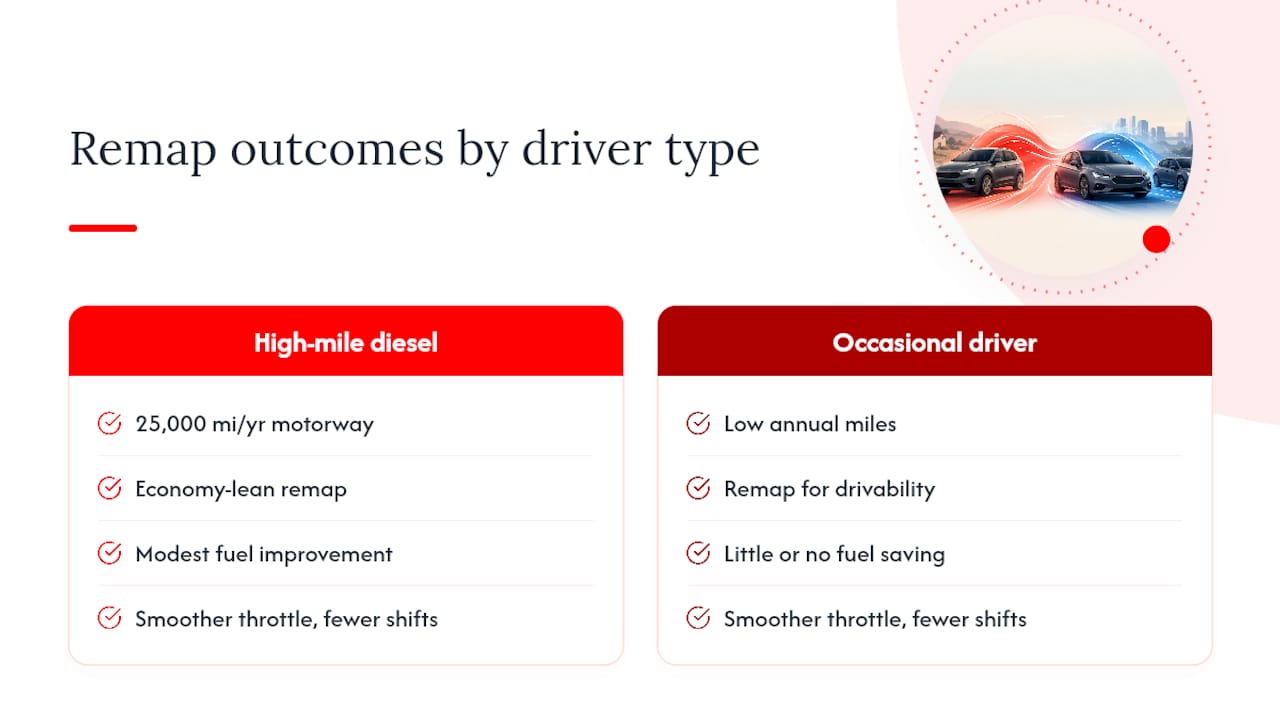
Take a high-mileage diesel commuter doing 25,000 motorway miles a year. An economy-leaning remap that improves consumption even modestly, combined with smoother throttle response reducing unnecessary gear changes, can pay for itself within months rather than years. An occasional weekend driver won’t see the same payback, the benefit there is drivability, not the fuel bill.
What does a remap cost and how long does it take?
Expect to pay somewhere between £250 and £400 for a professional software-only stage 1 remap in the UK, with the process itself usually wrapped up in a few hours at the workshop or via a mobile visit.
Reversibility is standard practice. A reputable tuner keeps a backup of your original factory map and can restore it on request, often within the same appointment.
Reversal doesn’t always undo the paper trail. Some manufacturers can flag that an ECU has been reflashed at some point, even after restoring the stock file.
Hardware changes complicate things. If a stage 2 remap assumed an upgraded intercooler or exhaust, reverting the software alone won’t return the car to its original state if those parts stay fitted.
The short version: software is reversible, consequences for warranty paperwork sometimes aren’t.
How do you choose a reputable tuner?
The gap between a good remap and a bad one usually comes down to who’s writing the file, not which car it’s going into. A generic file, the same tune sold to hundreds of different examples of your model, tends to give rough power delivery and inconsistent results, while a bespoke map built for your specific engine’s logged data delivers something smoother and more reliable long-term.
Before booking anywhere, check for:
Documented before-and-after data, not just a verbal promise of gains.
Independent reviews you can actually verify, not testimonials pulled from the tuner’s own site.
Pre-remap and post-remap diagnostic checks as standard, not an optional extra.
A clear explanation of what’s being changed and why, rather than a vague “we’ll sort it.”
Pro Tip: If a tuner can’t explain what a stage 1 map on your specific engine actually adjusts, that’s a sign the file isn’t bespoke, it’s off the shelf.
Performance Tuning NI builds maps specific to each vehicle rather than pushing generic files, backed by a five-star Google rating from thousands of completed remaps, which gives you something concrete to check against the list above before you commit.
Why the “bigger numbers, better car” mindset misses the point
The remapping conversation online is obsessed with peak bhp figures, and that’s the wrong lens for most everyday drivers. What actually changes how a car feels to live with is the mid-range torque curve, the difference between needing a downshift to overtake and simply squeezing the throttle.
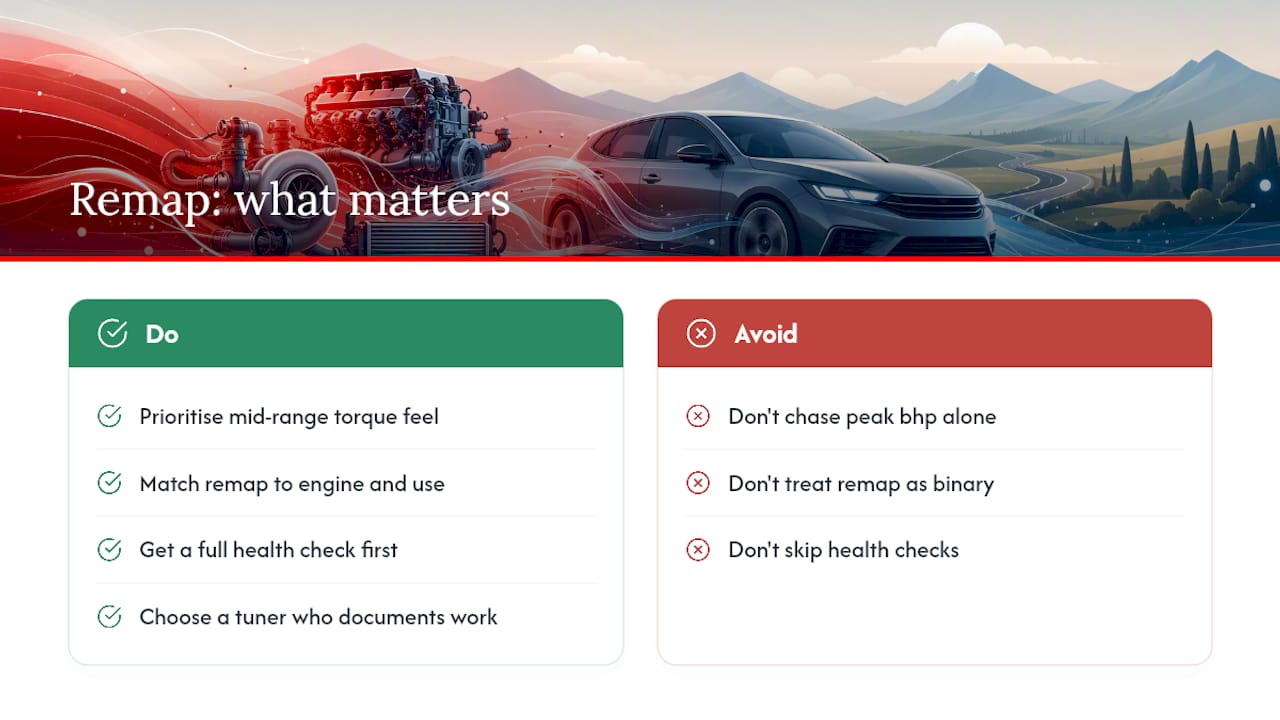
Conventional advice tends to treat remapping as a binary: worth it or not. That’s too simple. A remap on a well-maintained turbo diesel doing serious motorway miles is a different proposition entirely from the same remap on a naturally aspirated petrol car that does short urban trips. The engine type and your usage pattern should decide the answer, not a generic verdict borrowed from a forum thread.
If there’s one thing readers should prioritise above the performance numbers, it’s the health check. Skipping it doesn’t just risk warranty disputes, it risks turning a manageable existing fault into an expensive failure. Get the car assessed honestly first, choose a tuner who documents their work, and the performance gains take care of themselves.
— Mark
Ready for a remap that’s built around your car, not a generic file?
Performance Tuning NI writes bespoke maps rather than reusing generic files, the exact distinction this article has flagged as the difference between a smooth, reliable result and a rough one. Every remap starts with a proper health check and diagnostic scan, so you’re not layering extra torque onto an existing fault, and every original map is backed up before anything is written to the ECU.
[
Whether you’re weighing up a stage 1 remap for daily driving or want to know what your specific engine could realistically gain, the free remap calculator gives you a starting estimate by registration number. From there, book a remap or ECU tuning appointment at the workshop or arrange a mobile visit, and if the engine’s carrying carbon build up that’s masking its true response, pairing the remap with carbon cleaning is worth asking about at the same time.
Sources
Recommended