
E10's 10% Ethanol Poses Knock and Corrosion Risks for Remapped Cars
Running E10 in a remapped car is risky because your remap was calibrated to a specific fuel target, and E10’s chemistry pulls the engine away from that target. It can lean out the mixture, raise combustion temperatures, and corrode fuel-system parts over time. If you’ve already filled up with E10, don’t panic: check compatibility with the gov.uk tool, avoid extended driving on it, and top up with the correct fuel as soon as you can.
TL;DR:
A single tank of E10 is unlikely to cause immediate engine damage in a remapped car, but prolonged use risks corrosion and performance issues.
Compatibility depends on vehicle age, material condition, and aftermarket modifications, requiring physical inspection for older or altered engines.
Ethanol’s oxygen content leans the fuel mixture, raising combustion temperatures and risking knocking in remapped engines with limited thermal margin.
Check vehicle compatibility with official tools and manufacturer lists, and avoid running the tank near empty or on E10 for extended periods.
If E10 has been used, top up with the correct fuel promptly and consider a fuel-system inspection to prevent long-term damage.
Table of Contents
Why not to use E10 petrol in a remapped car
E10 contains up to 10% ethanol by volume, compared with a maximum of 5% in E5. That five-percentage-point jump sounds small on paper. It isn’t, once you understand what ethanol does to combustion chemistry.
Ethanol carries oxygen molecules that petrol doesn’t. That oxygen effectively enriches the fuel’s chemical profile, which raises octane rating but lowers energy density, meaning you burn more fuel to produce the same power. It also shifts the air to fuel ratio your engine management system is expecting to see.
A factory ECU has enough tolerance built in to handle that shift without drama. A remap doesn’t have the same margin. Custom tuning files push ignition timing further forward and, on turbocharged cars, increase boost pressure to extract more power. Both adjustments assume a specific fuel grade, usually 97 to 99 octane premium unleaded, sometimes still calibrated around E5.
Here’s what changes when ethanol content rises:
Octane rating increases, which sounds like a benefit, but the ECU doesn’t know that unless it’s specifically mapped for it.
Energy density drops, so the same throttle input delivers slightly less power and worse fuel economy.
Oxygen content in the fuel rises, pushing the air to fuel mixture leaner than the remap intended.
Combustion temperatures climb, particularly under load, because a leaner mixture burns hotter.
None of this matters much in a standard, unmodified engine running factory ignition timing. It matters considerably more once a tuner has already moved timing and boost closer to the engine’s limits.
How to check whether your remapped car tolerates E10
Start with the official vehicle compatibility checker, which covers the vast majority of cars sold in the UK by make, model and year. Cross-reference that against the ACEA compatibility list, which compiles manufacturer statements and sometimes flags exceptions the government tool misses, particularly on older or imported models.
Compatibility isn’t only about the engine. It’s about age and material composition, too:
Rubber fuel hoses and seals manufactured before the mid-2000s often weren’t designed for ethanol contact and can swell, crack or perish faster.
Plastic carburettor floats and fuel-line components, still found in some classic and modified setups, are similarly vulnerable.
Brass, copper and some aluminium alloys can corrode when ethanol-blended fuel absorbs water, which it does more readily than pure petrol.
Some manufacturers explicitly exclude specific engine families or pre-2011 models from their E10 approval lists, even when the compatibility checker gives a general green light for the model range.
If your car is over a decade old, or you’ve had aftermarket fuel-system work done, a physical inspection is worth booking before you assume the checker’s verdict settles the matter. A tuner or dealer can look at hose condition and injector wear in a way no online tool can replicate.
What actually happens when a remapped engine runs on E10
The mechanism is called mixture enleanment. Ethanol’s extra oxygen makes the engine “read” the fuel as richer than it is, so the ECU (or the remap’s fixed fuelling targets) delivers less fuel than the engine actually needs. That leaner mixture burns hotter, and a remap that’s already advanced ignition timing or increased boost pushes those temperatures higher still.
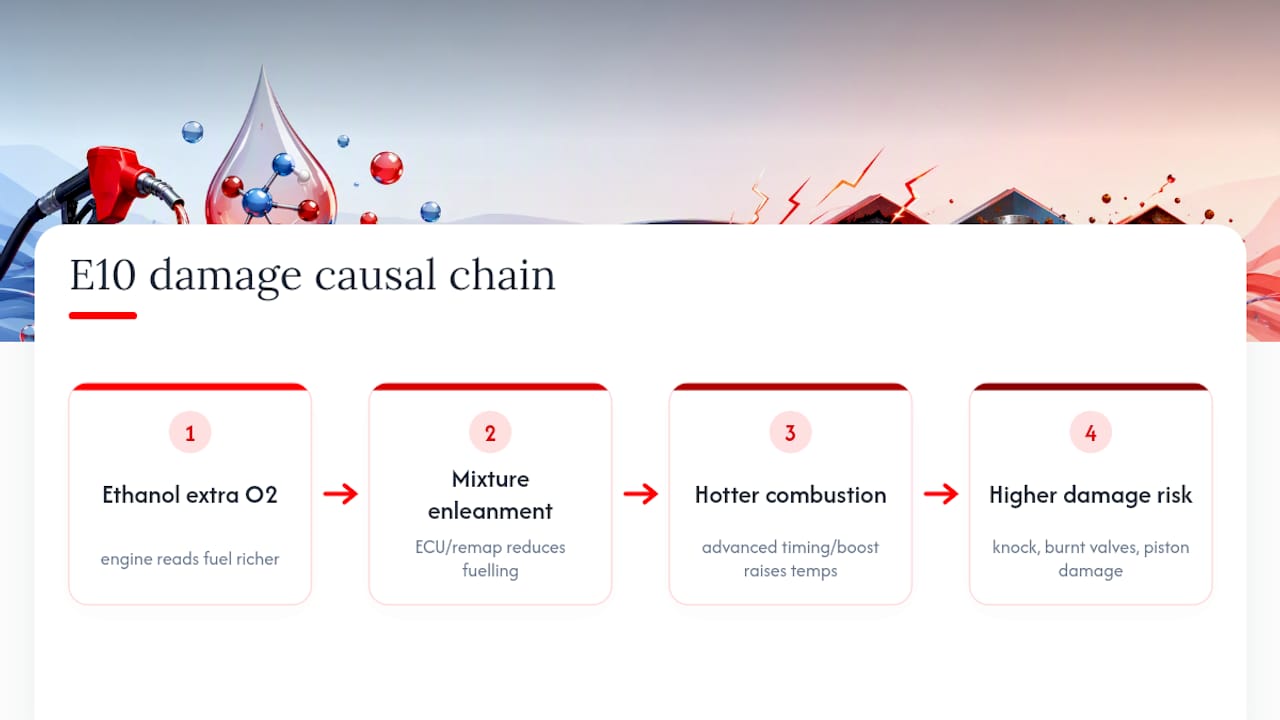
Sustained heat under load raises the risk of knock, burnt exhaust valves and, in worst cases, piston damage. A standard tune has more thermal margin to absorb that shift. A remap, by design, has less spare capacity.
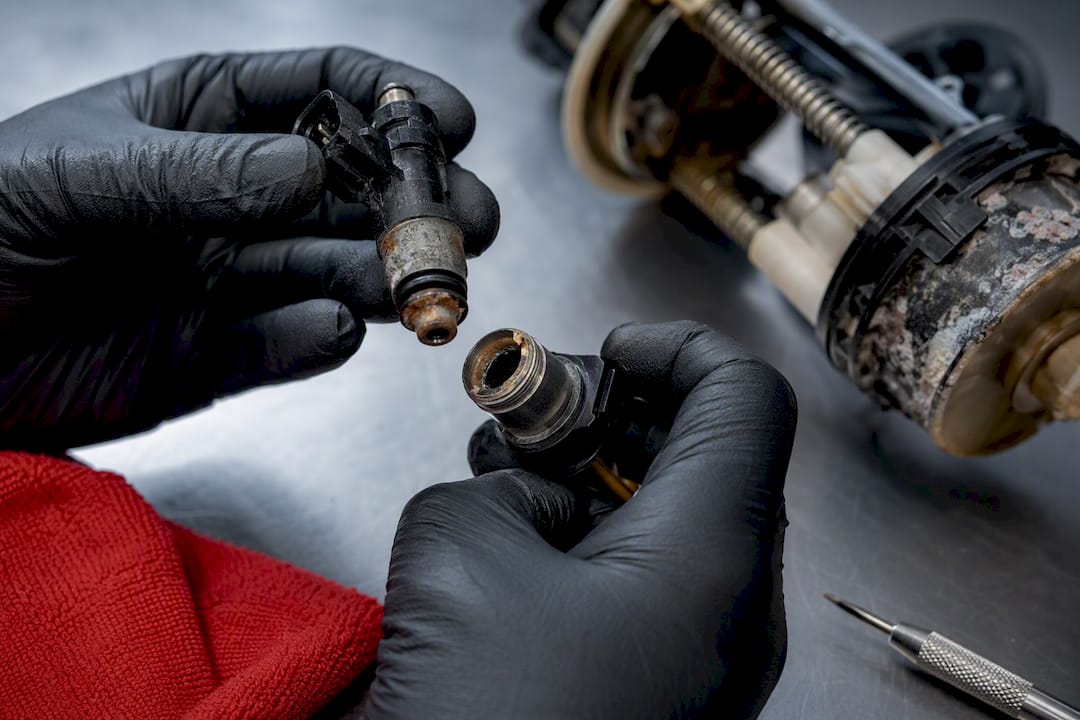
There’s a second, slower problem: water contamination. Ethanol absorbs atmospheric moisture more readily than petrol, and that water can corrode fuel-pump internals and injector components over months, not days. Watch for reduced throttle response, occasional misfires, noticeably higher fuel consumption, a fuel smell around the filler cap, or a check-engine light that wasn’t there before.
What to do if you’ve already put E10 in the tank
Don’t drain the tank in a panic. The gov.uk guidance is clear that a single tank in a non-compatible car is unlikely to cause immediate damage. It’s prolonged use that creates the corrosion risk, not one accidental fill.
Top up with the correct fuel as soon as convenient. Adding E5 or your specified 98/99 octane fuel dilutes the ethanol content rather than eliminating it, but it moves the mixture back toward what your remap expects.
Avoid running the tank down to empty hoping the E10 clears itself. Diluting is faster and gentler on the fuel system than repeated low-fuel driving.
Only consider a full drain if you’ve filled almost an entire tank with E10 in a car flagged as non-compatible, or if you notice symptoms like misfiring or a fuel smell.
Book a fuel-system check if the car is older, has covered high mileage on aftermarket fuel-system parts, or if warning signs appear after the fill.
For remapped cars specifically, stick to the fuel grade your tuner calibrated against, typically 98 or 99 octane, and treat E10 as a short-term compromise at best rather than a routine choice.
Pro Tip: Fuel additives marketed as “ethanol treatments” can help slow water absorption in the tank, but they don’t reverse corrosion that’s already happened and they’re not a substitute for running the octane grade your remap was built around.
Budget for the difference in scale here: swapping back to the right fuel costs nothing beyond the pump price. A fuel-system inspection is a modest workshop charge. Replacing corroded injectors or a failed fuel pump is a different order of expense entirely, which is exactly why catching this early matters.
Why remaps are built around one fuel grade in the first place
A custom remap isn’t a generic power boost. It’s a set of parameters, ignition timing, boost targets, fuelling maps, written around the specific octane rating and energy density of one fuel grade. Change the fuel and you’ve changed one half of an equation the tuner solved specifically for your engine.
A proper tuning workflow, whether at Performance Tuning NI or any competent specialist, starts with diagnostics before touching the map: checking existing fault codes, verifying fuel-system condition, and confirming what fuel grade the car will realistically run on. Dyno verification after remapping confirms the map performs as intended under load, on the fuel it was written for. If a customer needs a remap adjusted for a different fuel grade, that’s a recalibration job, not a five-minute tweak.
Custom remaps are typically built to improve throttle response and smooth out power delivery without pushing the engine outside safe operating limits, which only holds true if the fuel going in matches the fuel the map was built for. If you’re booking a fuel-related check, ask your tuner three things: what diagnostics they’ll run, whether a re-tune is needed for your fuel grade, and what the time and cost look like if it is. You can also read more on how remaps are calibrated to fuel grade before you book.
An editorial view on E10 and remapped engines
Most advice on this subject treats E10 as a universal villain or a non-issue, and both framings miss the point. The chemistry is nuanced: ethanol can raise octane and, in engines specifically calibrated for it, even improve combustion stability. The problem isn’t ethanol itself. It’s mismatch, a remap written for one fuel target running on a different one, with less thermal margin to absorb the difference than a standard tune ever had.
Where conventional advice falls short is in treating “check compatibility” as the end of the conversation. Compatibility checkers tell you what the manufacturer approved for a standard engine. They say nothing about whether your specific remap still holds once the fuel changes. That’s a tuner conversation, not a website lookup.
If you take one thing from this, prioritise the recalibration question over the panic question. A single tank of E10 won’t wreck your engine. Running a remap indefinitely on the wrong fuel grade, unchecked, eventually will.
— Mark
Sources
Confirm your car’s status directly with gov.uk’s E10 explainer and the compatibility checker. For technical depth on ethanol’s effect on older engines, the Classic Engines, Modern Fuel briefing is worth reading before any fuel-system work.
Recommended