
Northern Ireland Tuners Set Safe Remap Limits for High Mileage Cars
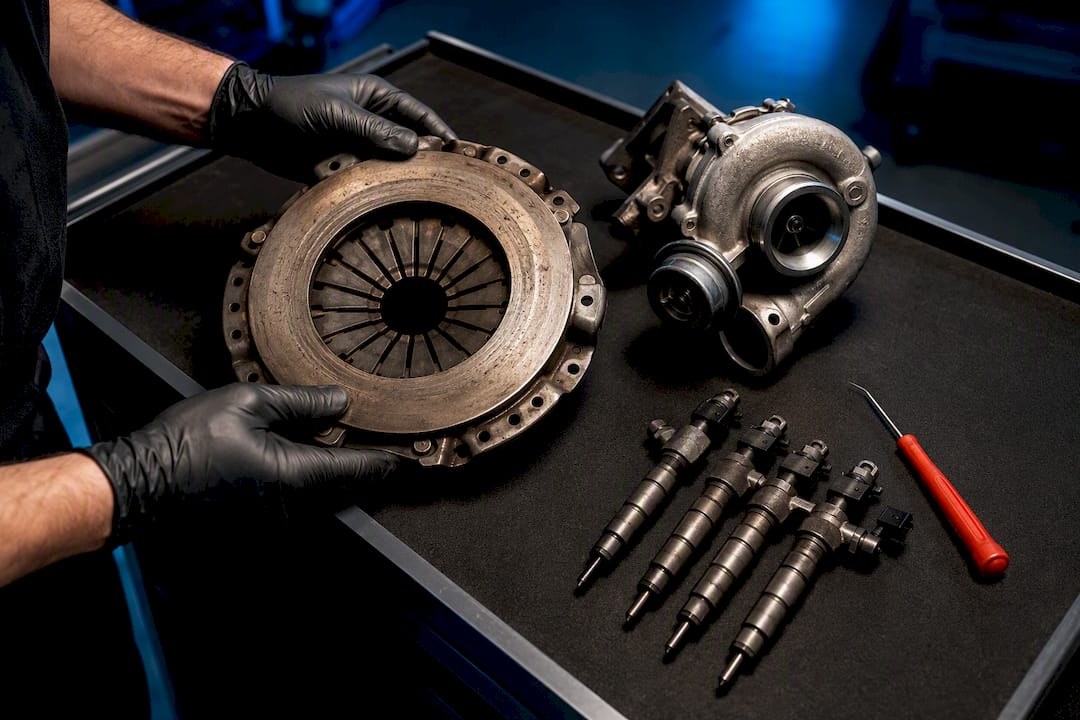
Whether a remap is safe depends on the car’s condition and the tune’s execution, not on hitting a fixed torque number. There is no single universal boost or torque ceiling that applies across makes, mileages and gearboxes. A remap is safe when three things line up: the vehicle passes a proper diagnostic health check, the calibration is bespoke rather than generic, and servicing is up to date before any file goes near the ECU.
TL;DR:
Safe remapping relies on thorough diagnostics, bespoke calibration, and up-to-date servicing, especially for high-mileage or worn components.
Most issues after remapping, such as clutch slip or turbo noise, indicate pre-existing weaknesses rather than new faults caused by the tune.
Limits for boost and torque are specific to each vehicle’s condition, usage, and drivetrain, not fixed universal numbers.
High-mileage cars can be remapped safely if diagnostics show no significant wear and support conservative tuning adjustments.
Declaring the remap to insurers and keeping original files are essential to avoid warranty disputes and facilitate repairs if needed.
Table of Contents
What safe remap limits actually mean for your ECU
An ECU remap rewrites the software targets that control how the engine behaves, not the hardware itself. On most cars this touches:
Boost pressure control (how hard the turbo is asked to work)
Fuelling maps (how much fuel is delivered under load)
Ignition timing (when the spark fires relative to piston position)
Torque limiters (the ceiling the ECU imposes at each gear and RPM)
Throttle mapping and rev/load tables
Each change has a mechanical knock-on effect. More boost stresses the turbo and intercooler. Advanced timing raises cylinder pressure and heat. Higher torque earlier in the rev range loads the clutch and gearbox harder than the factory ever intended. Push fuelling and boost too far on a diesel and you also shift the burden onto the DPF and EGR system, which were calibrated around the standard power output.
Stage 1 remaps generally work within the factory hardware’s safety margins, which is why reputable tuners can safely execute them on well-maintained cars without touching a single component. Stage 2 and beyond usually assume supporting hardware, like an upgraded clutch or flywheel, because the software is now asking parts to do more than they were designed for.
When is it actually safe to remap a car?
A responsible tuner runs through a fixed sequence before writing any new file. Skipping steps is where trouble starts.
Full diagnostic scan and live-data logging to clear existing fault codes and check sensor behaviour under load.
Oil and coolant condition check, plus a look at the intake system for leaks that would throw off fuelling calculations.
Turbo and boost control inspection, since a tired actuator or worn bearing will misbehave the moment boost targets rise.
Clutch and gearbox assessment, particularly on cars already showing signs of slip at standard power.
DPF/EGR status and smoke checks on diesels, because a partially blocked filter reacts badly to extra fuel.
Battery stabilisation before flashing, using a stable power supply so the write process cannot corrupt mid-flash.
Guides on safe remapping consistently point to the same core checklist: scan, service basics, and intake/boost leak checks, all done before the calibration changes anything.
Pro Tip: Always ask whether your original ECU file is being backed up before the new one is written. A proper backup means a fault or a change of heart can be reversed in minutes, not weeks.
What are the common failure signs after a remap?
A remap doesn’t create new mechanical problems out of nothing. It exposes weaknesses that were already sitting close to their limit, which is why the same faults keep showing up:
Clutch slip. Revs rise faster than road speed, especially under hard acceleration in a low gear. This is the most frequently reported issue after a torque increase, and it hits cars with a marginal clutch almost immediately.
Turbo trouble. A rising whine or siren-like noise, boost that swings instead of holding steady, or oil residue at the intercooler pipework.
DPF/EGR symptoms. More visible smoke, especially on diesels used mainly for short trips that never get the filter properly hot.
Warning lights and limp mode. The ECU’s own protections stepping in when a sensor reading falls outside expected range.
None of these mean the car is broken beyond repair. They mean the tune has found the weakest link in the chain, which is exactly the outcome a conservative, staged approach is designed to avoid.
How do you set a safe torque or boost limit without a fixed number?
Anyone quoting one torque figure as universally safe is oversimplifying. Safe limits depend on mileage, transmission type, cooling capacity and how the car is actually driven, not a spec sheet number lifted from a forum.
A workable process looks like this:
Start from a conservative baseline rather than the most aggressive file available for that engine code.
Data-log air/fuel ratio and knock activity while stepping torque up gradually, checking each increment before moving to the next.
Apply tighter limits for cars used for towing or heavy loads, where sustained high torque and exhaust temperature matter more than a peak dyno number.
Check clutch and gearbox torque ratings against the proposed target before committing to the final file, particularly on cars that have covered serious mileage.
Professional tuners describe safe limits as inherently contextual, shaped by drivetrain condition and duty cycle rather than a single benchmark figure that applies to every example of that engine. Verification then comes from data logging under real driving conditions, followed by a short-term and longer-term check to confirm nothing has drifted once the car is back in daily use. Anyone planning to tow regularly should also read up on how towing changes remap targets before assuming the same file suits both jobs.
Is it safe to remap a high-mileage car?
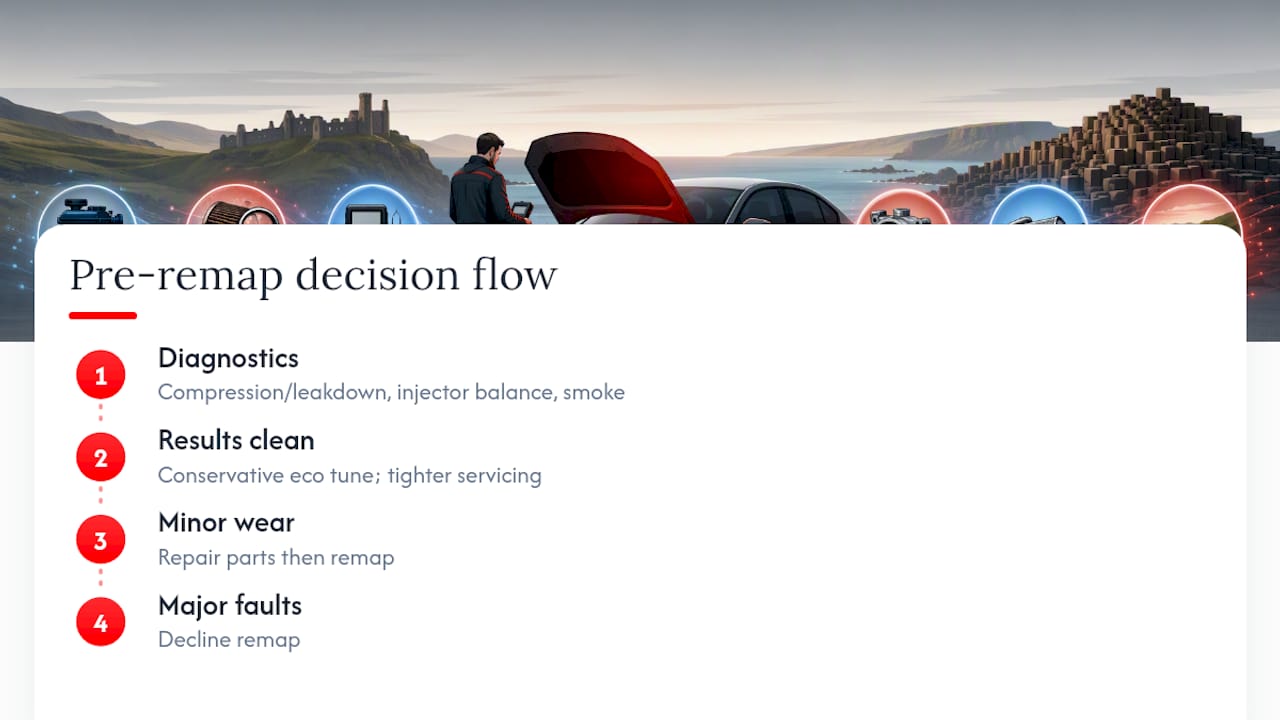
High mileage doesn’t automatically rule out remapping, but it does change what “safe” looks like. A clutch, turbo and set of injectors that have covered 100,000 miles have less spare capacity than the same parts at 20,000 miles, even if everything currently feels fine on the road.
Extra diagnostics earn their place here: a compression or leakdown test, injector balance readings, and a smoke check under load reveal wear that a basic scan won’t catch. Where those results come back clean, a conservative or eco-biased tune is usually the sensible route, since it favours drivability and fuel economy over chasing peak figures, alongside a tightened service schedule afterwards. Where they don’t, that’s the signal to repair first or decline the remap outright. Compression significantly down on one cylinder, heavy injector imbalance, or a turbo already showing play are reasonable grounds for any tuner to say no rather than mask a fault temporarily.
Does remapping affect warranty, insurance or MOT?
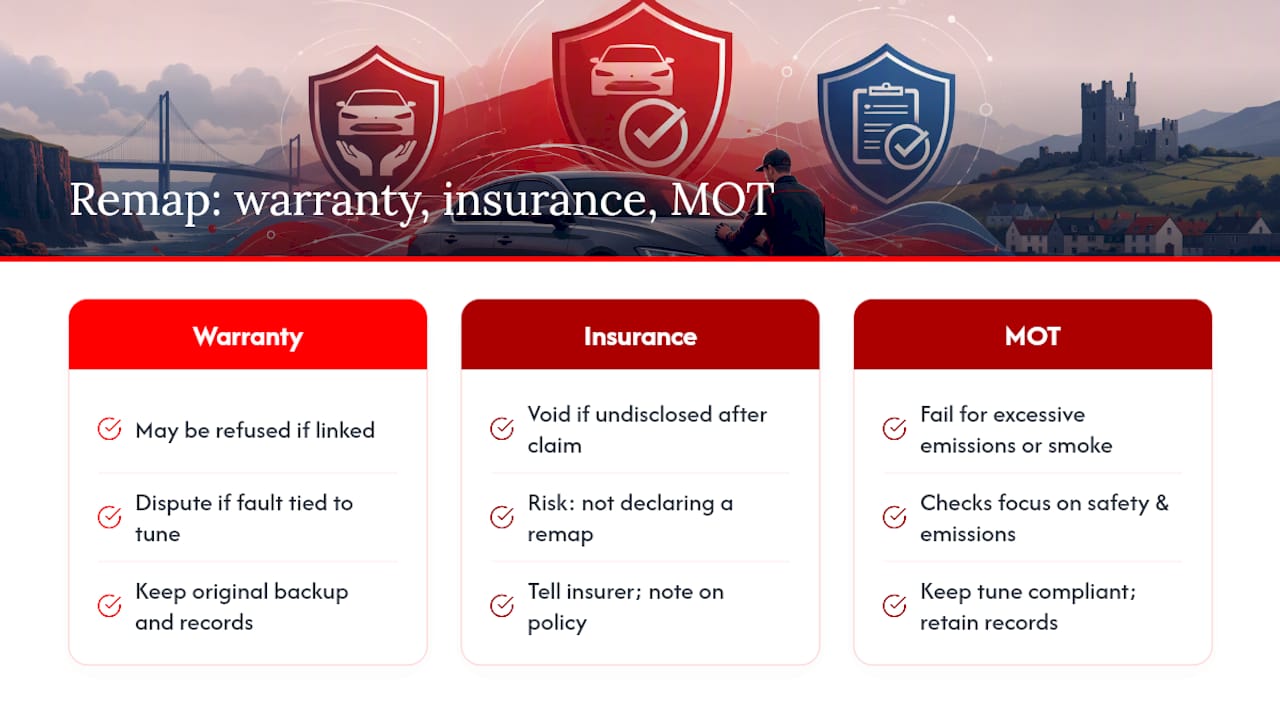
Manufacturers can, in principle, decline a warranty claim linked to a modification, so it’s worth understanding where that line sits before you commit. In practice, most disputes centre on whether the fault can be reasonably tied to the tune itself.
Insurance is more straightforward: not declaring a remap is the actual risk, not the remap itself. Insurers can void cover entirely if they discover an undisclosed modification after a claim, so tell them what’s been done and get it noted on the policy.
MOT testing focuses on safety and emissions, and excessive smoke or emissions faults can trigger a fail regardless of whether a car has been remapped. A clean, competently calibrated tune that keeps emissions within compliant limits shouldn’t cause problems at test time. Keep your original file backup and a record of what was done. It’s the fastest way to support a future claim or help a mechanic diagnose an unrelated fault.
Performance Tuning NI’s perspective: how limits get set in practice
Every remap starts the same way here: full diagnostic scan, battery support before flashing, then a custom file built for that specific car rather than a generic download. Data logging afterwards confirms the tune behaves as intended once it’s back on the road, not just on paper.
Customers often mention sharper throttle response and smoother power delivery rather than dramatic peak numbers. There have been cars turned down, too. A worn clutch or a turbo already on its way out doesn’t get remapped over. It gets flagged for repair first, because tuning around a failing part can speed up failure.
— Mark
Book a safe remap with Performance Tuning NI
If everything above tells you one thing, it’s that a good outcome depends on process, not luck. Diagnostics and a bespoke file build are run on every car, whether at a workshop or via a mobile appointment, backed by battery stabilisation and file backup practices.
[
Beyond the remap itself, engine carbon cleaning is worth pairing with it if your car has covered serious mileage on short trips, since it clears the kind of build-up that can undermine an otherwise well-set tune. If you’re weighing up whether your own car is a suitable candidate, our breakdown of what Northern Ireland owners should check first covers the same ground from a local perspective. When you’re ready, head to the engine remapping and ECU tuning page to book a diagnostic health check and get a bespoke quote for your vehicle.
Sources
FAQ
How safe is a Stage 2 remap?
Stage 2 pushes power beyond what factory hardware was designed for, so it’s only as safe as the supporting upgrades behind it, typically a stronger clutch, intercooler or injectors. Without those, the extra torque tends to expose the weakest component in the drivetrain first.
Can insurers tell if a car has been remapped?
Insurers can often detect a remap through diagnostic checks or during a claim investigation, which is exactly why disclosing it upfront matters more than trying to keep it quiet. Failing to declare a modification is grounds to void cover after a claim.
Is it safe to remap a high-mileage car?
It can be, provided extra checks like compression testing and injector balance come back clean and the tune is conservative rather than aggressive. Where wear is already showing, repairing the part first is the safer route than tuning around it.
Will a Stage 2 remap fail an MOT?
Not on emissions or smoke alone, provided the car still meets compliant limits at the time of testing. MOT failures relate to excessive visible smoke or emissions faults, not the presence of a remap itself.
Recommended