
Is ECU tuning legal in Northern Ireland? What you need to know!
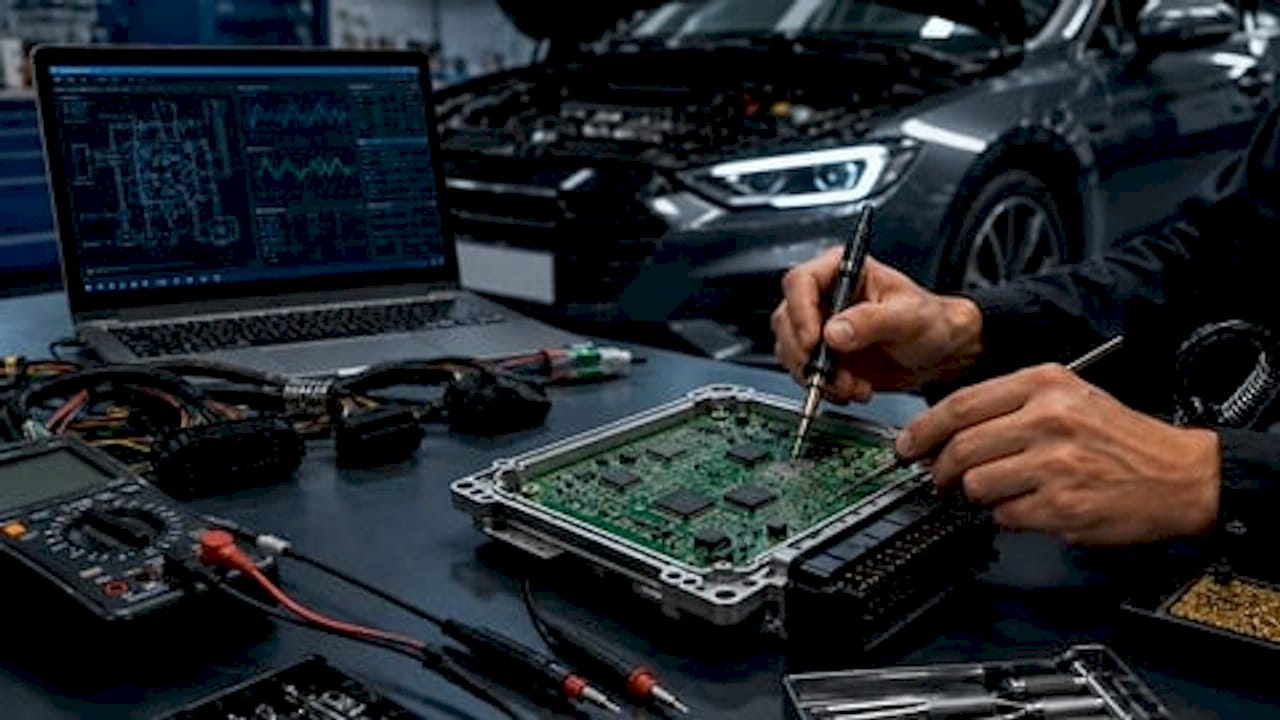
ECU tuning is legal in Northern Ireland, provided your vehicle continues to meet the emissions, noise and safety standards set at type approval. The act of modifying software is not itself unlawful; what matters is the outcome. If a remap pushes your car beyond its approved emissions class, disables safety systems, or causes it to fail an MOT, the vehicle becomes non-compliant and you face real legal and financial consequences.
Three things to do before you book a remap:
Tell your insurer. Failing to disclose a modification can void your cover entirely, not just adjust your premium.
Use a tuner who offers a reversible flash. You need the original ECU file backed up and restorable.
Confirm the tune keeps your vehicle within its type-approval emissions limits.
Table of Contents
What is ECU remapping and how does it work?
Your car’s Engine Control Unit (ECU) is essentially a computer that governs fuelling, ignition timing, boost pressure and torque limits. From the factory, manufacturers calibrate these parameters conservatively, often to suit multiple markets, fuel grades and warranty targets. A remap, or ECU tune, adjusts those parameters to extract more performance, better fuel economy, or both.
Common methods include:
OBD reflash: A technician connects a laptop or flasher tool to the car’s OBD port and overwrites the ECU’s calibration file. The most common professional method.
Bench flash: The ECU is removed and programmed directly on a bench, used when OBD access is restricted.
Piggyback/inline programmer: A secondary device intercepts signals between sensors and the ECU without altering the original file. Lower risk of bricking the ECU, but less precise.
Standalone ECU: The factory unit is replaced entirely. Common in motorsport builds, but rarely used for road cars.
Key terms worth knowing: calibration (the full set of ECU parameters), map (a specific lookup table within that calibration), CVN/Cal ID (checksums and identifiers that record which software version is installed), and dyno tune (a remap refined on a rolling road under load).

When does a remap make your vehicle illegal in the UK?
Chiptuning is allowed in principle provided the modified vehicle continues to meet the emissions, noise and safety limits that applied at factory delivery. The legal threshold is not the software change itself; it is the effect of that change on the vehicle’s compliance with its type approval.
Type approval is the certification that a vehicle model meets all applicable EU/UK standards before it enters the market. Altering the ECU does not automatically invalidate type approval, but certain outcomes do:
Emissions rising above the approved class limits (Euro 5, Euro 6, etc.)
Disabling or bypassing emissions hardware (DPF, EGR, catalytic converter, AdBlue system)
Altering OBD reporting so fault codes are suppressed or misreported
Noise levels exceeding the approved threshold
Tampering with immobilisers or speed limiters where legislation mandates them (e.g., commercial vehicles with legally required speed limiters)
Enforcement bodies and MOT stations can detect modified software through CVN/Cal ID checks. Every ECU calibration carries a checksum; if the value differs from the manufacturer’s approved version, authorities using OBD reads can flag the discrepancy. The Vehicle Certification Agency (VCA) administers UK type approval, and the DVSA sets MOT standards that include emissions and OBD checks.
Modification | Compliance risk | Likely outcome |
Performance remap (no hardware changes) | Low, if emissions stay within limits | Usually passes MOT if mapped correctly |
DPF/EGR/AdBlue delete | High | MOT fail, potential prosecution |
Catalytic converter removal | High | MOT fail, fines |
Speed limiter removal (commercial) | Very high | Prosecution, registration issues |
Immobiliser defeat | Very high | Insurance void, potential prosecution |
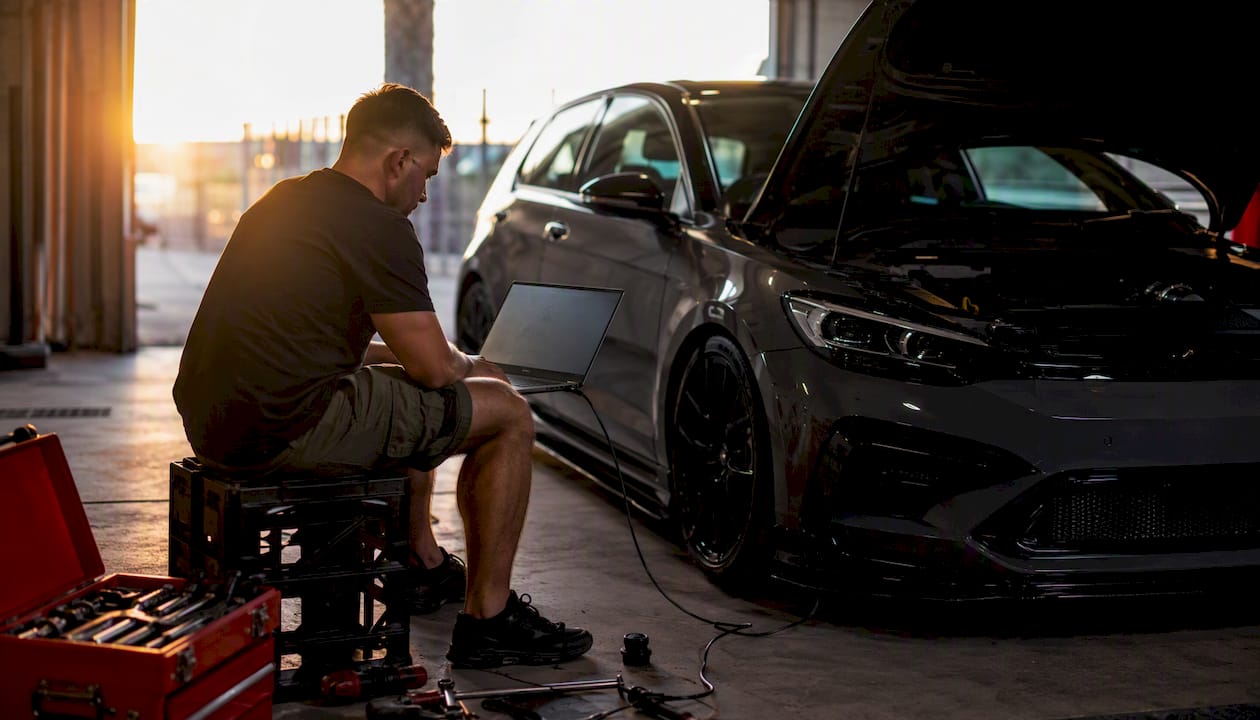
How does a remap affect your MOT and emissions test?
A remap that keeps emissions within the vehicle’s approved limits will not cause an MOT failure on those grounds. The problem arises when a tune increases tailpipe output beyond the test thresholds, suppresses OBD fault codes, or leaves the ECU with a CVN that does not match any approved calibration.
MOT testers check several things that a remap can affect:
Tailpipe emissions reading: Petrol cars face a CO and HC test; diesel cars face an opacity (smoke) test. A remap that increases fuelling without proper calibration can push these figures over the limit.
OBD fault codes: Testers plug into the OBD port and check for active or pending fault codes. A remap that masks codes or triggers new ones will cause a fail.
CVN/Cal ID: Not all MOT stations check this routinely, but DVSA guidance allows it, and it is standard practice in emissions enforcement checks.
Visual inspection: Testers look for missing or visibly modified emissions hardware.
Insurance, warranty and liability after a remap
Remapping is a material modification under most UK motor insurance policies. Failing to declare it is not a grey area: it is grounds for your insurer to void your policy, refuse a claim, or pursue you for costs already paid out on your behalf. The outcome of disclosure varies by insurer, but common responses include a premium increase, an additional excess, or a policy endorsement noting the modification.
Key points on each area:
Insurer disclosure: Tell your insurer before the remap, not after. Some specialist insurers welcome performance modifications; mainstream insurers may not. Get confirmation of continued cover in writing.
Manufacturer warranty: Most manufacturers will refuse warranty repairs where they can demonstrate the remap caused or contributed to the fault. Software changes are logged in the ECU, and dealer diagnostic tools can read them. A remap does not automatically void the entire warranty, but it gives the manufacturer grounds to reject claims on affected components.
Documentation from your tuner: Ask for a written scope of work.
Which modifications are illegal or high-risk for road use?
Some modifications sit in a clear legal grey zone; others are straightforwardly unlawful for road use in the UK. The highest-risk changes are those that disable or bypass emissions-related hardware or OBD monitoring, because they directly contravene anti-tampering provisions and type-approval requirements.
DPF delete: Removing or bypassing the diesel particulate filter causes an immediate MOT fail (testers check for its presence visually and via OBD). It also contravenes the Road Vehicles (Construction and Use) Regulations. More detail on the legal position of EGR and DPF work is worth reading before you commit.
AdBlue defeat/removal: Bypassing the selective catalytic reduction system on Euro 6 diesels is an emissions offence. The AdBlue removal question comes up frequently, but the legal risk for road use is substantial.
Modification | MOT outcome | Legal risk |
DPF delete | Fail (visual + OBD) | High: fines, reinstatement required |
EGR delete | Likely fail (OBD codes) | Moderate to high |
AdBlue defeat | Fail | High: emissions offence |
Cat removal | Fail | High: construction and use offence |
Defeat device software | Fail if detected | Very high: prosecution possible |
Speed limiter removal (commercial) | Fail | Very high: prosecution |
Can you legally tune your own car at home?
DIY tuning is not automatically illegal, but it carries risks that professional tuning largely mitigates. The legal question remains the same: does the result keep your vehicle within its type-approval limits? The practical question is whether you have the tools and knowledge to answer that confidently.
Risks specific to home reflashing:
Incorrect mapping: Improper calibration can overstress driveline components, cause detonation, or lead to premature mechanical failure. A bad map can destroy an engine.
Emissions breach: Without a rolling road and emissions analyser, you cannot verify that your tune stays within legal limits.
ECU brick: A failed flash can render the ECU inoperable, requiring replacement or specialist recovery.
Warranty and insurance: The same disclosure and warranty rules apply regardless of who performed the tune.
Detection: Even restoring the stock file does not guarantee that diagnostic traces of prior modification are erased. Advanced diagnostics can reveal that software has been altered, even after restoration.
If you proceed with DIY tuning, save the original ECU file before making any changes, use reputable and well-documented software, and verify emissions output on a rolling road before driving on public roads.
What does a compliance-focused remap actually look like?
A reputable tuner does not just hand you a power figure and send you on your way. The evidence they supply is what separates a compliant remap from a legal liability.
Concrete proof you should expect:
Before-and-after dyno charts showing power and torque across the rev range, with the original baseline recorded.
Emissions test log confirming tailpipe or OBD readings remain within the vehicle’s approved limits.
Original ECU file with CVN/Cal ID stored securely and restorable on request.
Written scope of work specifying which maps were altered, what the target parameters were, and what hardware (if any) was touched.
Questions to ask your tuner before you commit:
Can you restore my ECU to the original calibration if needed?
Do you provide a written emissions result from a rolling road session?
What qualifications or certifications do your technicians hold?
Is the remap covered by any form of guarantee?
Performancetuningni applies these practices as standard. Having tuned thousands of vehicles with a five-star Google rating, the team provides stock file backup, dyno evidence and written documentation with every engine remap. That paper trail is what makes a remap defensible, not just impressive on a power chart.
Pro Tip: Ask to see an example of the documentation package from a previous remap before you book. A tuner who cannot or will not show you a sample dyno chart and emissions log is one to avoid.
Performancetuningni: compliant remapping with the evidence to prove it
Performancetuningni offers something that matters more than a big power number: a remap you can actually defend. Every service includes stock ECU file backup and a written scope of work, so you have the documentation your insurer and MOT tester would want to see.
[
The service covers custom engine remapping for petrol and diesel vehicles, mobile remap appointments (the tuner comes to you), engine carbon cleaning as a complement to a fresh remap, and ECU restore if you ever need to return to stock. Thousands of vehicles tuned, a five-star Google rating, and a team that treats compliance as part of the job rather than an afterthought.
Check your vehicle’s eligibility and get an estimate with the free remap calculator, or go straight to the engine remapping service page to see what a compliant remap looks like for your car.
Useful sources and official guidance
DVSA MOT inspection manual — the official DVSA reference for what MOT testers check, including emissions and OBD procedures.
Vehicle Certification Agency (VCA) — UK type approval authority; the place to check a vehicle’s approved emissions class and certification status.
What California’s ECU law means for tuned cars — useful international comparator on CVN/Cal ID enforcement and OBD checks.
Performancetuningni remapping service — compliance-focused ECU remapping for petrol and diesel vehicles in Northern Ireland.
Performancetuningni blog — further reading on emissions, MOT implications and performance tuning.
Legal standards for modified vehicles: number plates — relevant for Northern Ireland and cross-border drivers considering the full legal presentation of a modified vehicle.
This article provides general information about ECU tuning regulations in the UK and is not legal advice. Rules change, and your specific vehicle, modification, and circumstances may affect the outcome. Confirm current requirements with the DVSA, VCA, your insurer, or a qualified legal professional before proceeding.
Recommended