
8 EGR Valve Symptoms Drivers Must Diagnose Before Buying Parts
Rough idle, stalling at low speed, a knock under load, black smoke, or a check engine light with an EGR code: these are the symptoms that most reliably point to a faulty EGR valve. Engine knock or white smoke with a coolant smell needs immediate attention, ideally a tow rather than a drive. For everything else, a code scan or a call to a diagnostic garage is the sensible next move.
TL;DR:
Most faults involve carbon buildup or electrical issues, with rough idle and stalling signals indicating a stuck-open EGR valve.
Engine knock under load or white smoke with coolant smell suggests a failed EGR cooler requiring immediate attention and towing.
Diagnostic codes P0401 and P0402 help identify whether the valve is stuck open or closed, guiding the appropriate repair steps.
Proper diagnosis involves reading fault codes, checking live data, and inspecting the port, rather than rushing to replace parts based solely on symptoms.
Cleaning the valve often suffices unless mechanical seizure or sensor failure occurs, in which case replacement is necessary and costs vary widely.
Table of Contents
What does the EGR valve do, and why does it fail?
The EGR valve recycles a measured amount of exhaust gas back into the intake, lowering combustion temperatures and cutting NOx emissions. It’s mostly active at low to medium load and idle, when combustion runs hottest relative to demand, and it closes off during hard acceleration when you need full airflow.
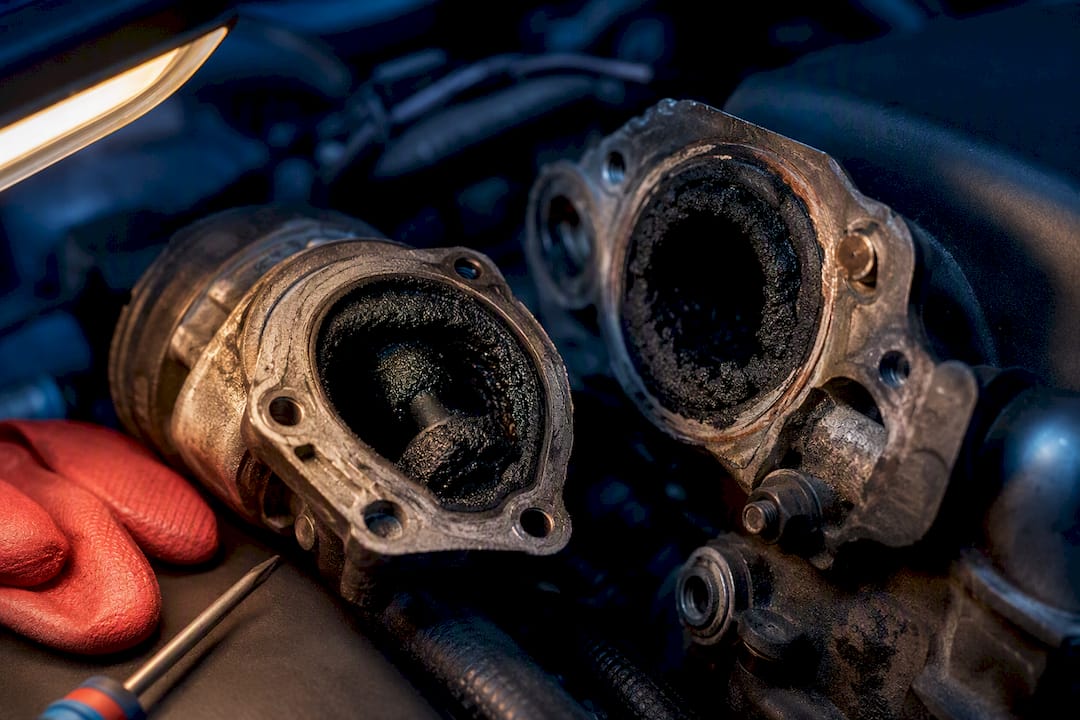
Carbon buildup is the most common reason EGR valves fail, coating the valve and its passages until it can no longer open or close fully. Diesels are particularly prone to this because their exhaust carries more soot, and short journeys make it worse: the engine never gets hot enough for long enough to burn off the deposits building up around the valve seat.
Electrical faults are the other main culprit. Position sensors drift or fail, wiring corrodes, and vacuum-operated valves lose their control signal entirely. On some engines the EGR cooler itself degrades internally, cracking and letting coolant leak into the exhaust or intake side. That’s a different problem from a dirty valve, and usually a more urgent one.
Signs of a faulty EGR valve, and what each one means
Symptoms split fairly cleanly into two camps depending on whether the valve is stuck open or stuck closed, and knowing which camp you’re in saves a lot of guesswork at the garage.
Common EGR valve failure signs include:
Rough or unstable idle, particularly when the engine is cold or just after a stop
Stalling, especially when coasting to a junction or slowing for a roundabout
Hesitation or a flat feeling under acceleration, as though the engine has lost a gear of power
A knock or pinging sound under load, often mistaken for a fuel problem
Black smoke from the exhaust on diesels
Noticeably higher fuel consumption than you’d expect for the mileage
A check engine light paired with a P0400-series code
A failed emissions check or MOT, usually tied to elevated NOx
That list covers the eight most frequently reported EGR failure signs across petrol and diesel engines, and most owners experience two or three of them together rather than one in isolation.
A stuck-open valve lets exhaust gas flow into the intake constantly, including when the engine doesn’t want it. That’s what produces rough idling, stalling on deceleration, and hesitation off the line, because the engine is trying to run on a diluted, oxygen-poor charge at exactly the moments it needs a clean one.
A stuck-closed valve does the opposite: no exhaust gas ever gets recirculated, so combustion temperatures run hotter than the engine was designed for. That’s the usual cause of engine knock or pinging under load, and it also tends to push NOx output up, which is why stuck-closed faults are the ones that most often fail an emissions test. Drivers sometimes hear the knock and reach for higher-octane fuel, but if the root cause is a lack of exhaust gas cooling the combustion chamber, better fuel won’t touch it and the engine stays at risk of knock-related damage.
Intermittent faults, usually electrical rather than mechanical, tend to produce symptoms that come and go: the light appears for a few days then clears itself, or the rough idle only shows up on a cold morning.
Two symptoms deserve a category of their own: engine knock under sustained load, and white smoke from the exhaust with a sweet coolant smell. Both point towards conditions that can cause real engine damage if you keep driving, and the second usually means an EGR cooler has failed and is leaking coolant into the exhaust or intake, which calls for a tow rather than a drive to the garage.
How does a bad EGR valve affect emissions and your MOT?
A stuck-closed valve pushes NOx output up, and that’s the specific pollutant most likely to trigger a failed emission or MOT test. A stuck-open valve or heavy carbon fouling tends to increase particulate matter instead, which adds load to the diesel particulate filter and can accelerate DPF clogging over time. Related soot symptoms are worth checking against what diesel smoke on acceleration actually indicates, since the two problems often overlap.
An EGR cooler leak sits in a different bracket altogether. Coolant loss and white exhaust smoke aren’t an emissions inconvenience, they’re a mechanical failure that can lead to overheating or head gasket damage if ignored, which makes it the one EGR fault where booking “sometime this week” isn’t good enough.
How do you diagnose an EGR issue properly?
Guessing at parts is the expensive way to fix an EGR fault. The correct sequence starts with reading the stored codes, then narrows down from there rather than jumping straight to a new valve.
EGR-related codes generally fall in the P0400 to P0409 range, and two of them come up more than any others:
P0401 (insufficient EGR flow): usually points to blocked passages or a valve stuck closed, and is commonly the code behind engine knock and high-NOx emissions failures.
P0402 (excessive EGR flow): usually points to a valve stuck open or a seat that no longer seals properly, and tends to line up with rough idle and stalling.
The practical diagnostic steps, in order:
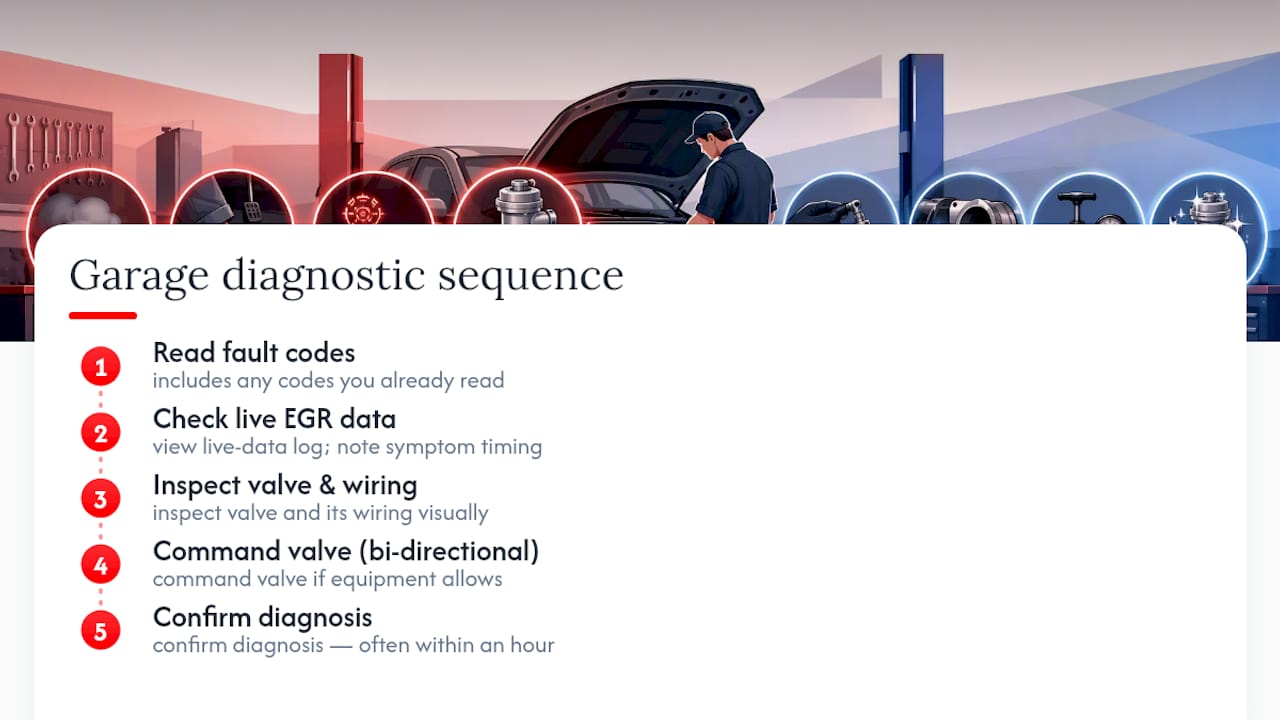
Read the stored codes with an OBD-II scanner and note whether it’s a P0401, P0402, or a different code in the P0400 to P0409 range.
Check live data for EGR position and duty cycle while the engine runs, comparing commanded position against actual position.
Carry out a visual inspection: vacuum lines, electrical connectors, and the state of carbon buildup inside the EGR port.
If your scan tool supports it, command the valve open and closed directly and watch how the engine responds.
A proper test also rules out ignition, fuel, MAF, and vacuum faults that mimic EGR symptoms, since a check engine light on its own doesn’t confirm the valve is actually the problem. Tools designed for electronic engine diagnostics and bi-directional testing are what make step four possible, and they’re increasingly common in independent garages rather than just main dealers.
Pro Tip: If you’ve got access to a bi-directional scan tool, command the EGR valve open while the engine idles under light load and watch the timing and knock sensor data. A knock that appears the instant you command the valve closed is about as clear a confirmation as you’ll get without pulling the valve out.
Cleaning, repair, or replacement: what actually works?
Light to moderate carbon buildup usually responds well to cleaning, whether that’s a chemical treatment, a full removal and manual clean of the valve and ports, or a broader engine carbon clean. Full removal tends to outperform spraying cleaner in while the valve stays installed, particularly once deposits have hardened.
Replacement becomes the realistic option once the valve has seized mechanically, the position sensor or wiring has failed electrically, or the cooler itself is cracked and leaking. No amount of cleaning fixes a broken sensor or a leaking cooler.
Costs vary widely by vehicle and by whether it’s the valve or the cooler that’s failed, so treat any figure quoted online as a rough guide rather than a promise. One thing worth avoiding entirely: clearing the code without fixing the cause just delays the same fault, and fitting an EGR delete for road use sits outside UK emissions rules rather than solving the underlying problem.
When should you book a diagnostic, and what will the garage do?
Engine knock under load, or white smoke paired with a coolant smell, needs booking in immediately, ideally with the car off the road until it’s seen. Rough idle, a stray check engine light, or slightly higher fuel use can usually wait for a normal appointment slot.
A technician will typically read the fault codes, check live EGR data, inspect the valve and its wiring, and command the valve if the equipment allows, often inside an hour for a straightforward case. Bring along any codes you’ve already read yourself, note when the symptoms show up (cold start, motorway, idle), and ask whether they can show you the live-data log, since it makes the difference between a confirmed diagnosis and a guess.
What we see on the ramp at Performance Tuning NI
Diesels booked in for “loss of power” often turn out to have soot patterns consistent with a partially blocked EGR passage, frequently alongside a recurring P0401. Cleaning resolves most of these; a handful of need a new valve. Two rules keep costs down: check live data before touching a spanner, and inspect visually before ordering parts.
Why most EGR advice skips the step that actually matters
Most guides list symptoms and stop there, leaving drivers to guess whether their rough idle means a £40 clean or a £400 replacement. That gap between “here’s what’s wrong” and “here’s what to actually do about it” is where most unnecessary spending happens.
The judgement worth taking from workshop experience is straightforward: a symptom alone never confirms which failure mode you’ve got, and live data confirms it faster than swapping parts and hoping. Conventional advice tends to jump straight to “replace the valve,” when in a lot of cases a proper clean, or even confirming the fault sits elsewhere entirely (a vacuum leak, a failing MAF sensor), would have solved it for a fraction of the cost.
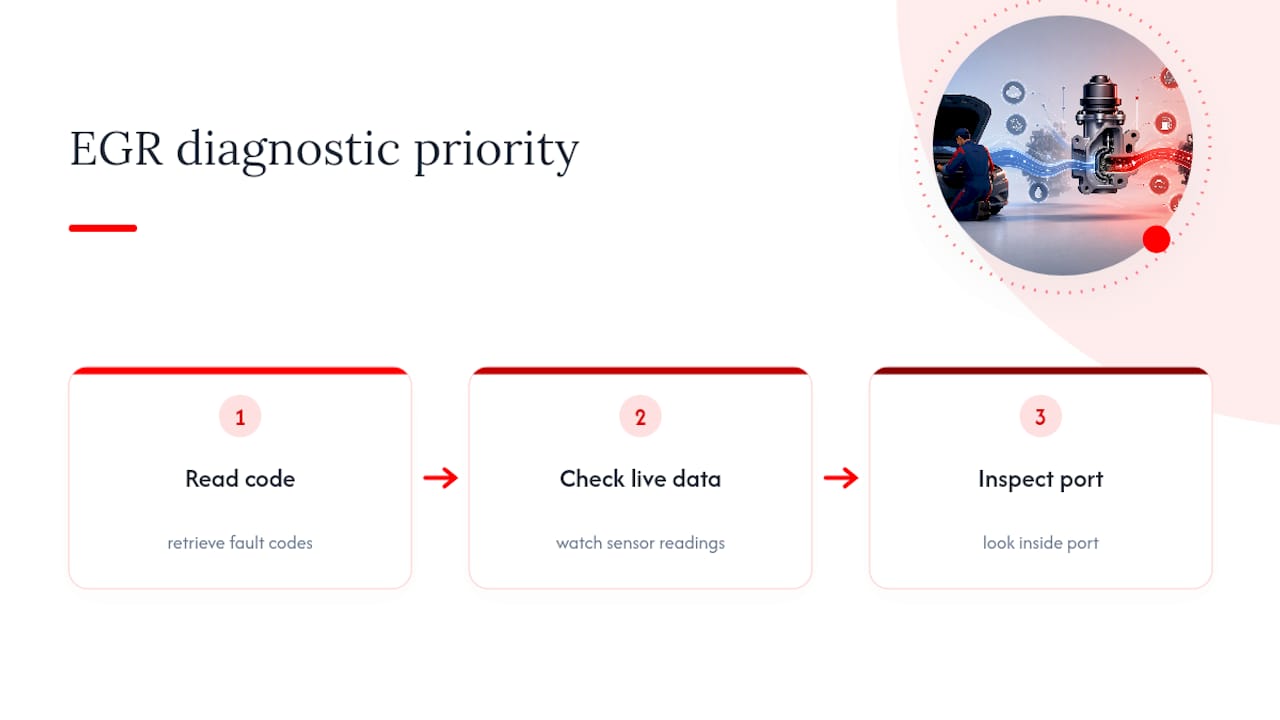
If there’s one thing to prioritise, it’s this: read the code, check live data, look inside the port before you buy anything. Everything else, including whether to book a clean, a replacement, or a wider look at how the engine’s running overall, follows from that first step rather than from the symptom list alone.
— Mark
Getting your EGR sorted without the guesswork
Diagnostic steps above are run as standard, not as an upsell, to confirm a cause before any parts get ordered or any bill gets written. For carbon-related faults, that often means an engine carbon clean rather than a full valve replacement, and it’s frequently bundled with a remap for owners who want both the fault sorted and the engine running properly afterwards.
[
Booking is straightforward: bring whatever codes you’ve already read, describe when the symptoms show up, and technicians will scan, check live data, and inspect the valve before recommending anything. If a remap is also on your mind, the engine remapping and ECU tuning service covers both petrol and diesel vehicles, and mobile appointments are available for drivers who’d rather not sit in a waiting room. Get in touch to book a diagnostic slot and find out exactly what’s causing your symptoms before you spend a penny on parts.
Sources
FAQ
Can I just clean my EGR valve without removing it?
Chemical cleaners applied while the valve stays fitted can help with light carbon deposits, but full removal and manual cleaning tends to work better once buildup has hardened.
Will a car pass an MOT with a faulty EGR valve?
Not reliably: a stuck-closed valve raises NOx output, which is one of the emissions checks tested during an MOT, so a valve stuck fully closed often causes a failure.
Can you still drive with a bad EGR valve?
Rough idle or reduced power on their own are usually safe to drive with to a garage, but engine knock under load or white smoke with a coolant smell mean you should stop and arrange a tow instead.
How much does it cost to replace an EGR valve?
Costs vary a lot by vehicle and by whether the valve or the cooler has failed, so a proper diagnosis before quoting is the only reliable way to know your figure.
Recommended