
Stage 1–3 ECU Remapping: What Tuners at Performance Tuning NI Do
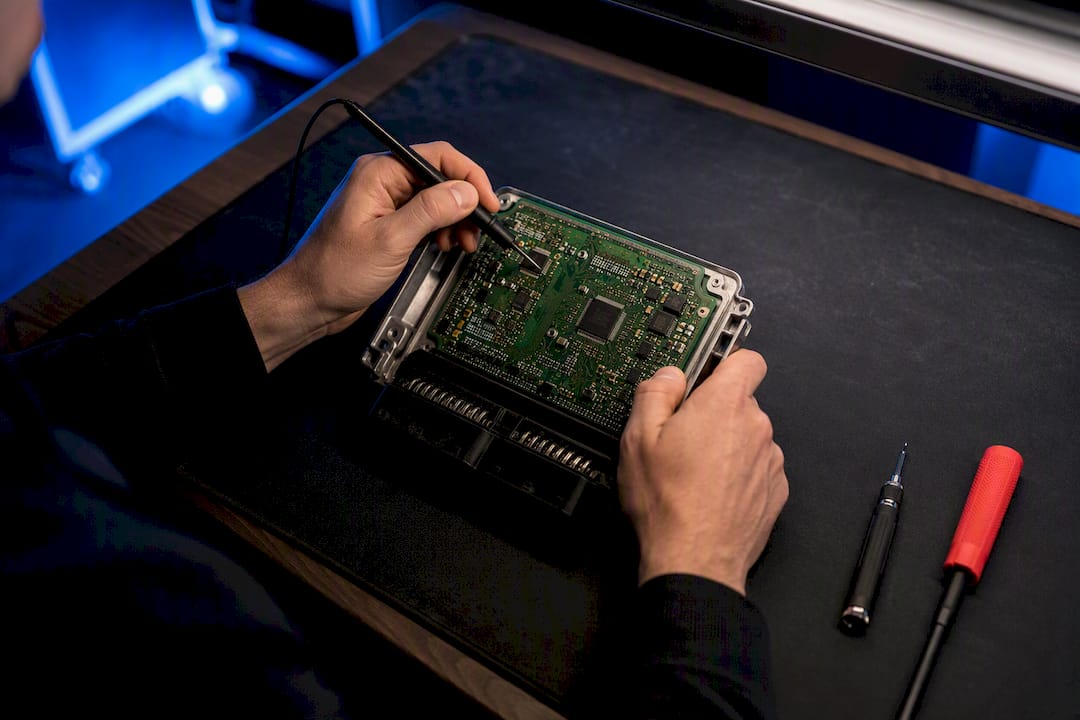
ECU remapping rewrites the software that runs your engine, adjusting fuelling, ignition timing, and boost pressure to release power the manufacturer left on the table for safety and market reasons. Done properly, it delivers stronger acceleration, sharper throttle response, and sometimes better fuel economy at a cruise. Done badly, or on an engine with existing faults, it can strain the clutch, turbo, or gearbox and may affect your warranty and insurance.
TL;DR:
Most gains from a remap occur when the engine’s factory safety margins are unlocked, typically in Stage 1 tunes that stay within original hardware limits.
Supporting hardware upgrades in Stage 2 and 3 remaps enable larger power boosts but increase the risk of strain on components like the clutch and turbo.
Proper diagnostics, including fault scans and system inspections, are essential beforehand to ensure the engine can handle increased loads safely.
The remapping process involves backing up the original file, flashing the new calibration, and conducting real-world testing to validate results.
Reversion to stock is possible through software, but owners should keep backups and proof of tuning to protect warranty and insurance claims.
Table of Contents
What is ECU remapping and how does it actually work?
The ECU (Engine Control Unit) is the computer that decides how much fuel to inject, when to fire the spark plugs, how much boost a turbo should build, and where to cap torque. It makes thousands of these decisions a second, all governed by tables of data called maps. A map might tell the engine “at 3,000rpm and 50% throttle, inject this much fuel and advance the spark by this many degrees.”
Manufacturers deliberately build in margin. They calibrate for the worst climate, the worst fuel quality, and a customer base that never services on schedule. That margin is precisely what remapping unlocks: the software is adjusted so the engine runs closer to its real mechanical potential rather than the cautious, one-size-fits-all setting it left the factory with.
Getting the new calibration onto the ECU is called flashing, and there are a few routes:
OBD flashing, done through the diagnostic port under the dashboard, is the quickest and most common method for the majority of vehicles.
Bench or boot flashing involves removing the ECU itself and connecting it directly to specialist hardware, which some vehicles require when the OBD port is locked down or unsupported.
Manufacturer-specific interfaces are sometimes needed on newer or more security-hardened ECUs.
This is a different process from old-school “chip tuning,” which meant physically desoldering and replacing an EEPROM chip. Modern ECU tuning is almost always software-based, flashed rather than swapped, though plenty of people still use the two terms interchangeably.
What do Stage 1, Stage 2 and Stage 3 remaps mean?
Remapping is generally split into three stages, and knowing which one applies to your car changes everything about cost, risk, and expected gains.
Stage 1 is software-only tuning that stays within the factory hardware’s limits. Carwow’s tuning breakdown describes this as adjusting fuel, ignition, and boost maps without touching the intercooler, exhaust, or turbo. Most everyday drivers land here.
Stage 2 adds supporting hardware, typically a larger intercooler, a freer-flowing exhaust, or an upgraded air filter, alongside a revised software calibration. The extra airflow lets the software push further than a Stage 1 file safely could.
Stage 3 involves major mechanical changes, often a bigger turbo, forged internals, or an upgraded fuel system, paired with comprehensive recalibration to match. Gains are the largest of the three stages, but so is the risk if any component in the chain is under-specified.
For a daily driver who wants better throttle response and stronger mid-range pull without touching a spanner, Stage 1 is usually the sensible starting point. Stage 2 and 3 suit owners chasing track-day numbers or who have already invested in supporting hardware, and they demand a tuner who can datalog properly rather than push a generic file.
What are the real benefits and trade-offs of a remap?
The upside is straightforward: more usable power, stronger torque (particularly noticeable on turbocharged diesels and petrols), and a noticeably crisper throttle. What surprises a lot of owners is the fuel economy question, because it cuts both ways.
Remapping can genuinely improve fuel efficiency at a steady cruise, since the engine reaches the torque needed to hold speed with less throttle input. But give a driver more power and they tend to use it, and that enthusiasm at the accelerator routinely cancels out any economy gained at motorway speeds.
There are trade-offs beyond the fuel tank:
Clutches, dual-mass flywheels, and gearboxes see more stress, particularly on cars where these were already marginal from the factory.
Turbochargers run harder and may need closer oil-change attention.
Removing emissions hardware such as EGR valves or DPFs to “support” a remap creates genuine legal exposure, separate from the remap itself.
A properly calibrated Stage 1 remap on a well-maintained engine is a fundamentally safe modification, because the factory safety margins still apply. Most reported failures trace back to poor-quality files or mechanical issues that existed before the remap, not the remap itself. Read more on what ECU remapping benefits look like in practice for different engine types.
What should a pre-remap health check cover?
A remap exposes weaknesses that were already there. A tuner who skips diagnostics before flashing is gambling with your engine, not tuning it.
Fault code scan across all relevant modules, not just the engine ECU, to catch anything already flagged.
Turbo and fuel system inspection, checking for boost leaks, worn actuators, or fuel delivery issues that a new map would only aggravate.
Compression testing where the engine’s history or symptoms suggest it might be warranted, particularly on higher-mileage cars.
Resolution of any existing faults before proceeding. A remap should never be used to mask a problem that needs mechanical attention.
Before booking, ask the tuner directly for three things: a stock file backup, datalogging during and after the flash, and the option of a dyno run to confirm results. If a shop offers a generic file with no backup and no logs, that is a clear warning sign, not a shortcut worth taking.
Pro Tip: Ask to see an anonymised datalog from a similar vehicle before you book. A tuner confident in their calibration will have no problem showing you one.
What actually happens during the remapping session?
The process follows a consistent sequence, whatever stage you’re having done.
The tuner reads and saves the original stock file first, either via OBD or bench connection, creating the backup that makes reversion possible later.
The new calibration is written and flashed onto the ECU, adjusting the relevant fuel, ignition, and boost tables for your stage and hardware.
A road test and datalogging session follow, checking real-world behaviour rather than relying on theory.
Where a rolling road is available, a dyno run provides before-and-after figures and confirms the map holds up under sustained load.
Timing varies more than people expect. A standard OBD flash typically takes under an hour, while bench or boot work adds time for ECU removal and refitting. Custom file development, where the tuner builds a calibration from scratch rather than adapting an existing one, can take considerably longer. If anything feels off after the initial road test, a competent tuner will adjust or revert before you leave.
What are the legal, warranty and insurance implications?
Remapping itself isn’t illegal in the UK. Problems arise from what some owners pair it with, particularly removing emissions equipment like a DPF or EGR valve, which is likely to fail an MOT and breaches environmental regulations regardless of whether a remap is involved.
Warranty is a separate concern. Manufacturers can often detect software changes through flash counters or diagnostic logs recorded during servicing, and a detected remap can affect warranty claims on related components even after the software is reverted.
Tell your insurer about the remap. Undisclosed modifications can void a claim entirely, which costs far more than any premium increase.
Keep the stock file backup and any dyno or datalog reports as documented proof of what was done and when.
Choose a tuner who logs pre-remap diagnostics as standard, since that paperwork protects you if a warranty dispute ever arises.
Can a remap be reversed, and what changes afterwards?
A remap is reversible in software terms; the tuner simply flashes the original stock file back. That said, a remap being reversible doesn’t guarantee restored warranty entitlement, since some manufacturers retain a record of the modification regardless.
Aftercare matters more than most owners expect. Remapped engines can become more sensitive to fuel quality, and some tuners recommend higher-octane fuel or shorter service intervals to match the extra load.
Watch for warning lights, unusual noises, or hesitation, and get back to your tuner promptly if anything appears.
Mention the remap to any buyer at resale, along with your documentation, since transparency tends to reassure rather than deter serious buyers.
Pro Tip: Keep your dyno chart and datalog with the car’s paperwork. It answers the “has this been remapped?” question before a buyer even has to ask it.
Notes from Performance Tuning NI on what actually works
Performance Tuning NI builds each remap around the individual vehicle, running pre-diagnostic checks and keeping the original file backed up before any flash goes ahead. Customers most often report sharper throttle response and smoother power delivery rather than a dramatic personality change. For real examples, the engine remapping case studies cover specific vehicles and results in more detail.
How do you interpret remapping results and performance metrics?
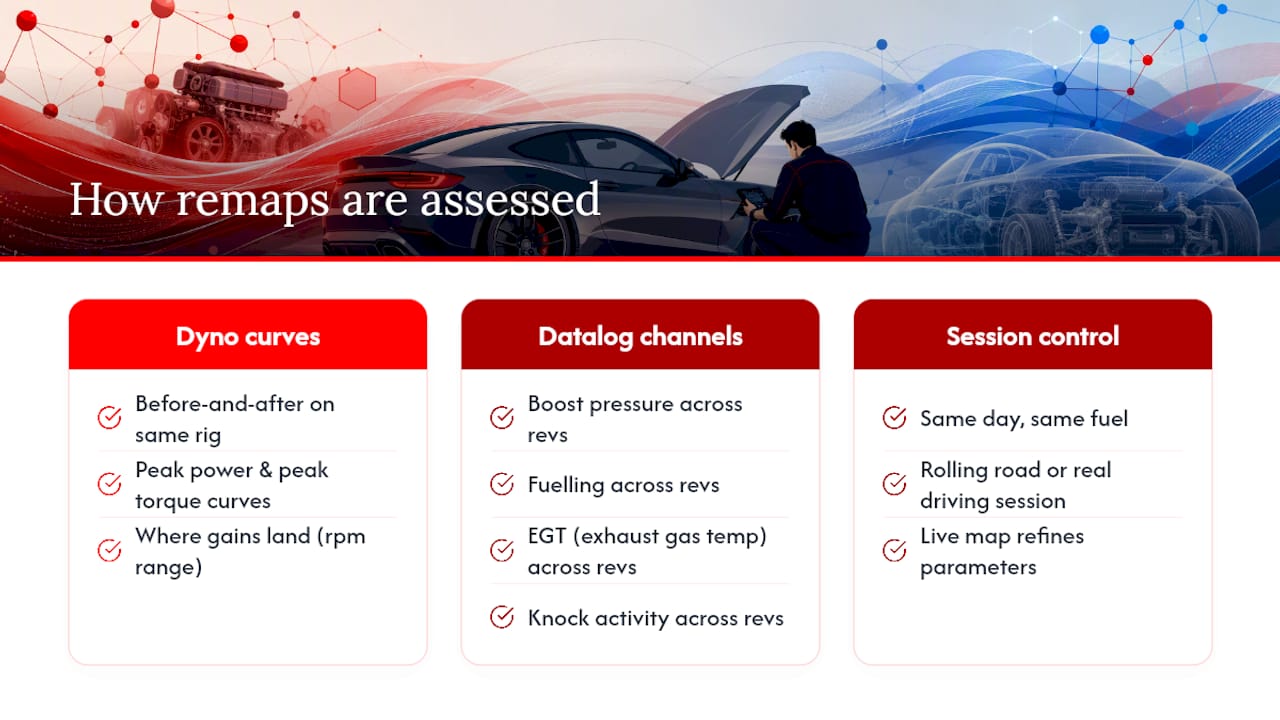
A dyno chart or datalog is only as useful as your ability to read it correctly. Two numbers dominate most reports: peak power and peak torque, usually shown as a curve rather than a single figure. What matters more than the peak, though, is where on the curve the gains actually land.
A remap that adds torque low in the rev range, say from 1,500 to 3,000rpm on a diesel, transforms everyday drivability even if the peak power figure looks modest on paper. That’s the gain you feel pulling away from a junction, not just on a wide-open motorway slip road. Conversely, a big peak number that only appears briefly near the redline does little for daily use.
Before-and-after dyno runs on the same rig, same day, same fuel are the only fair comparison. Figures quoted from different dynos, different weather conditions, or different fuel batches can vary by a meaningful margin without any change to the tune itself, which is why reputable tuners keep both runs from a single session rather than comparing against a manufacturer’s claimed factory figures.
Datalogs tell the rest of the story: exhaust gas temperatures, boost pressure, fuelling, and knock activity across the rev range. A live map built from a rolling road or real driving session refines these parameters far more accurately than a generic file ever could, because it’s reacting to your engine’s actual behaviour rather than an assumed average. If a tuner can’t show you EGT and knock data alongside the power curve, ask why, because that’s the data that confirms the map is safe, not just fast.
Which brands and providers dominate ECU remapping?
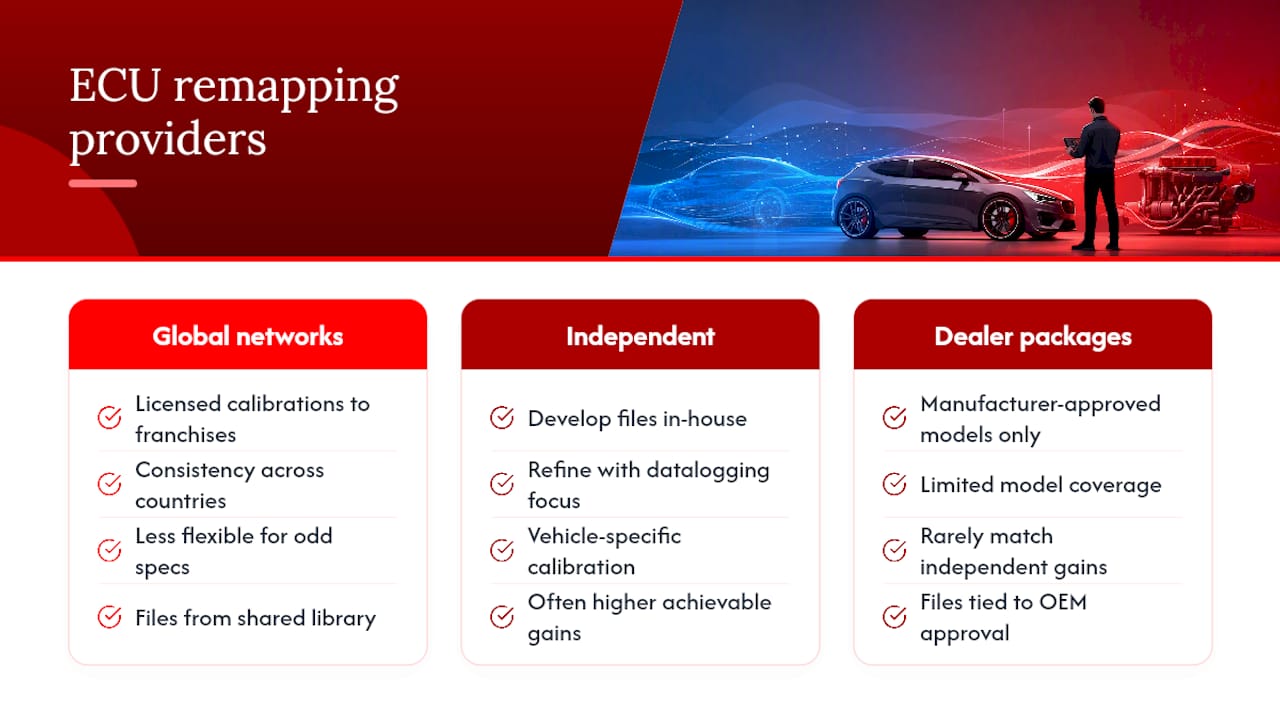
The remapping market splits broadly into three types of provider. Global tuning file networks license calibrations to franchised installers across multiple countries, offering consistency but sometimes less flexibility for an unusual specification. Independent specialists develop and refine their own files in-house, often with a stronger focus on datalogging and vehicle-specific calibration rather than working from a shared library. Dealer-fitted “performance packages” exist too, though these are typically limited to models the manufacturer has pre-approved and rarely match the gains available from independent tuning.
Software and hardware choice also varies between providers. Some rely entirely on OBD-based flashing tools for speed and convenience, while others invest in bench and boot equipment to handle ECUs that lock out OBD access, plus rolling-road facilities for live mapping and verification. That equipment difference often separates a shop offering generic downloaded files from one calibrating specifically for your car. For readers weighing up live-mapping value more broadly, resources like DFSK’s E5 PHEV coverage illustrate how rolling-road verification plays out across different powertrain types.
What should actually guide your choice isn’t the badge on the shopfront but whether the provider backs its work with pre-diagnostic checks, a stock file backup, and proof of results rather than a promise.
A tuner’s honest view on getting this right
Safety comes before numbers, every time. A tune is only as good as the checks behind it, the data validating it, and how well it matches what you actually want from the car. If you’re unsure where your engine stands, get a proper diagnostic first.
— Mark
Book a remap with pre-diagnostic checks and proof of results
Some tuners offer remaps built around the actual car rather than using generic files. A thorough remap process starts with pre-diagnostic checks and backing up the original file; results ideally include datalogs or dyno charts to show changes clearly.
[
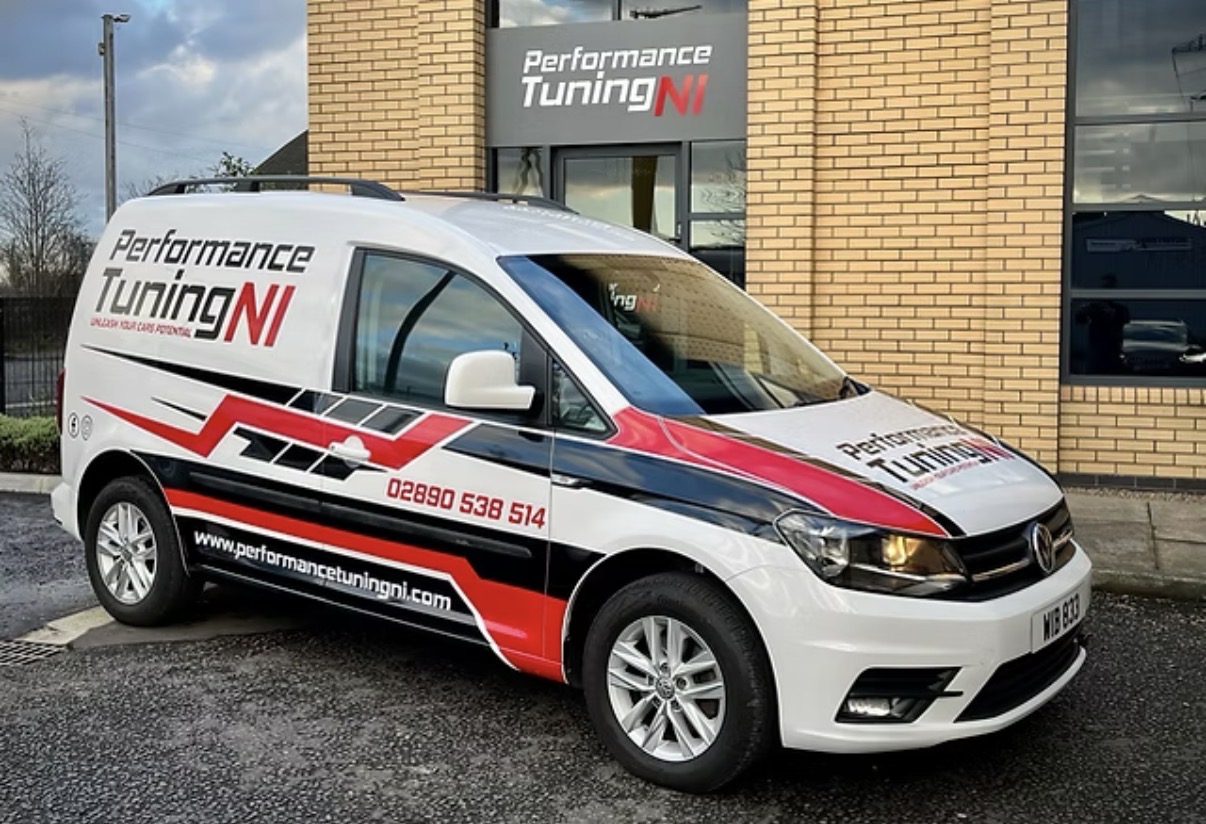
Services may include custom engine remaps, AdBlue deletes, performance and economy tuning, and speed limiter removal to address different owner goals like power or economy improvements. Some providers offer mobile appointments that allow remapping work to be done at a convenient location. If your engine could use closer attention to carbon build-up rather than a full remap, Carbon Cleaning is worth considering alongside or instead of tuning work.
Get a price for your specific vehicle through the remap calculator and see what a properly checked, properly logged remap costs before you commit to anything.
Sources
FAQ
Is remapping bad for the engine?
Not when it’s done properly on a mechanically sound engine, since factory safety margins remain in place. Most reported failures come from poor-quality generic files or existing mechanical faults the remap exposed, not the remap itself.
Is ECU remapping legal in the UK?
Yes, remapping the software itself is legal, but removing emissions hardware such as a DPF or EGR valve to accompany it is not and will likely cause an MOT failure.
Can I remap my ECU myself?
Technically some tools allow it, but without proper diagnostics, datalogging, or dyno verification you risk masking an existing fault or damaging the engine, which is why professional pre-checks matter.
Will a remapped car pass MOT?
A well-executed remap that leaves emissions equipment intact should pass an MOT without issue, since the test doesn’t check for software modifications directly, only the physical hardware and emissions output.
Recommended