
Fix DPF Regeneration Safely: Drive 20–30 Minutes or Book a Workshop
DPF regeneration is the process of burning off accumulated soot inside your diesel particulate filter so exhaust gases keep flowing properly. If the DPF warning light comes on steady, get onto a dual carriageway or motorway and drive at a sustained speed for 20 to 30 minutes. If the light flashes, the engine loses power, or the warning stays on after that drive, stop and book a diagnostic check rather than repeating the trip.
TL;DR:
Most drivers can passively regenerate the DPF through a sustained motorway or dual carriageway drive at 50mph or higher for 20 to 30 minutes once the engine is fully warmed up.
Failed regenerations often indicate upstream faults such as faulty sensors, overfueling injectors, or exhaust leaks, which prevent the process from reaching required temperatures.
Ash buildup cannot be cleared by driving; it requires physical cleaning or replacement, unlike soot, which burns off during proper regeneration cycles.
For persistent DPF warnings or regeneration failures, a professional diagnostic is essential to identify and fix upstream issues before attempting forced regen.
A forced regeneration by a technician involves a controlled process that can take 40 to 90 minutes and should only be performed after verifying all system preconditions.
Table of Contents
What is DPF regeneration and why does the filter clog?
A diesel particulate filter sits in the exhaust and traps soot particles before they leave the tailpipe. This is why diesel cars pass modern emissions standards at all. Regeneration is the filter’s clean-up cycle: exhaust heat oxidises the trapped soot into carbon dioxide and ash, clearing the honeycomb structure so exhaust gas can pass through freely again.
Soot and ash are not the same thing, and mixing them up causes most of the confusion around DPF problems.
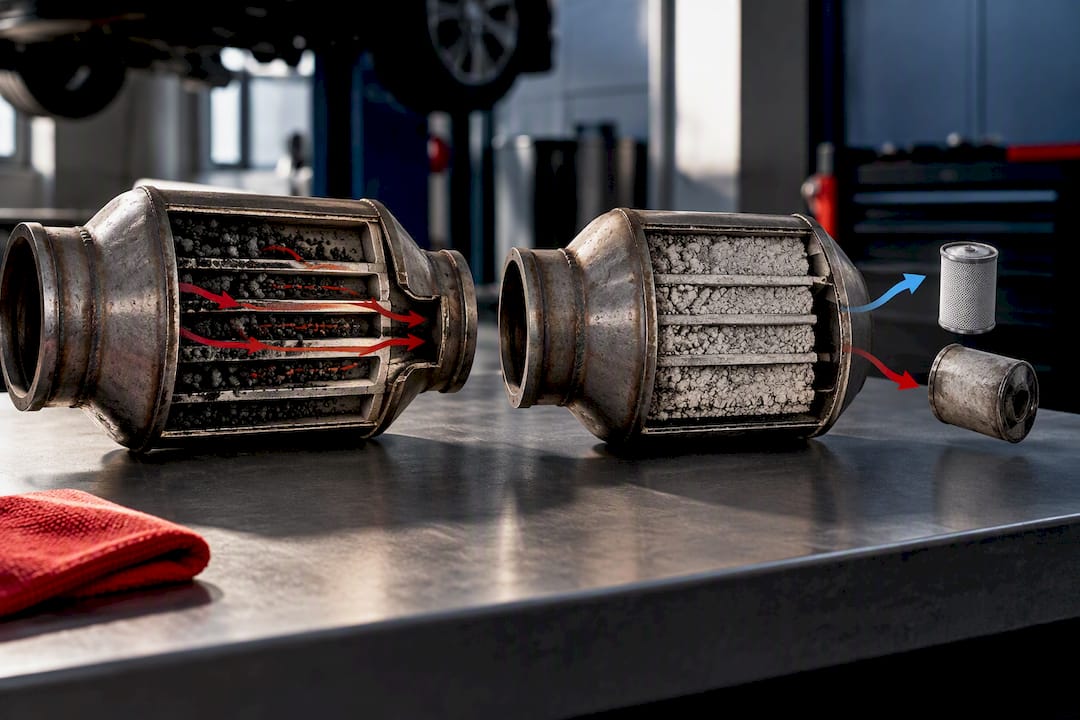
Soot is unburnt carbon from combustion. It burns away during a proper regen cycle, which is the entire point of the process.
Ash is what’s left after soot burns. It’s a mineral residue from oil additives and fuel, and no amount of driving or regen cycles will remove it.
A DPF that’s full of soot regenerates and recovers. A DPF that’s clogged with ash needs physical cleaning or replacement, because ash simply sits there and builds up over the filter’s life.
A blocked filter chokes the engine, raising exhaust backpressure until you notice sluggish acceleration, worse fuel economy, and eventually a limp mode that caps engine speed.
Passive, active and forced regeneration: what’s the difference?
Three distinct processes get lumped together under the single term “DPF regeneration,” and knowing which one applies to your situation saves a lot of guesswork.
Passive regeneration happens without any driver input or dashboard warning. It occurs when exhaust gas temperatures at the filter inlet climb naturally during sustained motorway driving, high enough to oxidise soot continuously as it’s trapped. If you regularly do longer runs at speed, your DPF may never need anything else.
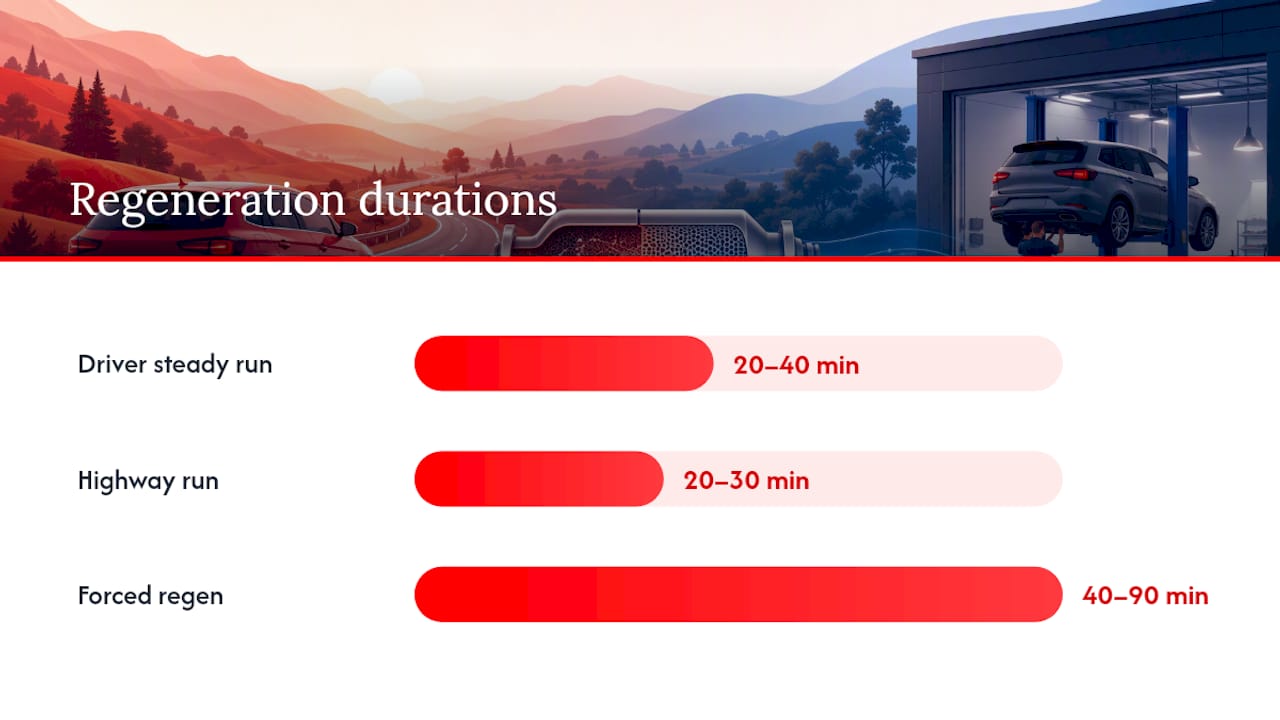
Active regeneration kicks in automatically when the engine control unit detects the soot load has climbed past a threshold, typically somewhere around 45 to 60%. The ECU responds with post-injection fuel dosing or a dedicated dosing injector to push exhaust temperatures higher, and a typical active cycle runs for 20 to 40 minutes. You’ll often notice a slightly raised idle and a faint hot smell, but nothing alarming.
Forced (parked) regeneration is different again. It’s initiated by a technician using a diagnostic tool while the vehicle is stationary, and it only proceeds once the system confirms the engine is fully warmed up and no fault codes are blocking the cycle.
Technicians lean on temperature data to judge whether any of these cycles are actually working:
Regen temperature benchmarks: passive regen typically runs at 450 to 550°C, active regen at 550 to 650°C, and forced or parked regen at 600 to 700°C. If a cycle isn’t reaching its expected range, something upstream is stopping it.
How can you tell if a regen is happening or overdue?
The dashboard tells you most of what you need to know, if you know what you’re looking at.
A steady DPF lamp usually means the system has flagged a high soot load and wants a sustained drive. A flashing lamp or a lamp paired with an engine warning means something has gone wrong with the process itself, not just soot buildup.
A “regen in progress” message, where fitted, confirms the ECU is actively running a cycle. Don’t switch off or slow to idle during this window.
A derate or reduced power warning signals the engine management system has pulled back performance to protect the filter, and driving alone won’t fix it.
Physical clues help too: a marginally higher idle speed, a faint hot or acrid smell from the exhaust, and slightly elevated coolant temperature all point to an active cycle running.
Live OBD data, where you have access to it, shows soot load percentage, differential pressure across the filter, and exhaust gas temperature directly, which is far more reliable than guessing from smell alone.
Interrupting a regen part way through, by switching off or dropping to idle, wastes the heat build up and can leave the filter worse off than before you started.
How to encourage a successful regen, and what a forced regen involves
Most regen problems are avoidable with the right drive, not a workshop visit. Here’s the sequence that actually works:
Get the engine to full operating temperature first. Ten minutes of stop start driving before a regen attempt wastes time; the coolant and oil both need to be up to temperature.
Find a safe, legal stretch of road where you can hold a steady 50mph or higher for 20 to 40 minutes without heavy braking or idling. A dual carriageway or motorway run of 20 to 30 minutes resolves the issue for many diesel cars.
Keep the revs and load consistent. Avoid coasting downhill in gear or repeatedly lifting off the throttle, since both drop exhaust temperature and can stall the cycle.
Watch the dashboard, if your instrument cluster shows a progress message, don’t stop until it clears or you’ve completed the full run.
Pro Tip: If you can’t find a safe road with room to hold speed, don’t force it in traffic. A stop-start regen attempt in town driving usually fails and just burns fuel for nothing.
When a driver run doesn’t clear the warning, a workshop moves to a forced regen. That’s a controlled procedure, not a quick fix. A technician runs a full diagnostic scan first, confirms there are no fault codes blocking the cycle, checks that temperature and differential pressure sensors are reading correctly, and only then initiates the forced regen through a scan tool. The cycle is monitored throughout and can take 40 to 90 minutes depending on how heavily the filter is loaded. A competent technician won’t even start a forced regen if the preconditions aren’t met, because doing so risks damaging the filter for no benefit.
Why does regeneration keep failing, and how do you fix it?
A DPF that won’t regenerate is almost always a symptom of something else going wrong upstream, not a fault with the filter itself.
Injector overfuelling or worn injectors dump excess fuel into the cylinders, which raises soot production faster than the filter can clear it.
Turbo and boost problems starve the engine of the air it needs for clean combustion, again increasing soot output.
Failed temperature or differential pressure sensors feed the ECU bad data, so it either refuses to trigger a regen or ends one prematurely.
Exhaust leaks upstream of the DPF drop exhaust temperature before it reaches the filter, undermining every regen attempt.
The diagnostic sequence a technician follows starts with a full fault code scan, then moves to reading live soot load percentage and pressure differential, checking sensor accuracy, and inspecting the diesel oxidation catalyst and any fuel dosing components for faults.
Here’s where the soot versus ash distinction matters again: if the filter is soot loaded, fixing the root cause and running a regen usually clears it. If it’s ash loaded, no regen will help, and physical cleaning or replacement is the only real fix. Repeatedly forcing regens on a filter that’s ash bound, or on a vehicle with an unresolved upstream fault, risks cracking the substrate permanently. At that point you’ve turned a cleanable problem into a filter replacement.
What maintenance actually prevents DPF blockages?
Prevention comes down to a handful of habits, most of which cost nothing beyond a change in driving pattern.
Do a longer run at speed periodically. If your driving is mostly short urban trips, a 20 to 30 minute motorway drive once every week or two gives the filter a chance to regenerate passively before soot builds up to problem levels.
Use a low-ash (Low SAPS) engine oil at the correct service interval. Higher-ash oils accelerate the exact buildup that no regen cycle can remove.
Buy quality diesel from reputable filling stations. Poor fuel quality contributes to higher soot production and can affect injector performance over time.
Keep the EGR valve serviced. A sticking or fouled EGR valve is one of the most common triggers for failed regen cycles, so periodic cleaning pays for itself.
Have sensors checked at service intervals, particularly the differential pressure and exhaust temperature sensors, since a failing sensor can silently prevent regen long before you notice symptoms.
Pro Tip: If you’ve had the DPF replaced recently and it’s still throwing warnings, ask whether the ECU adaptation values were reset. A filter replacement that isn’t paired with an ECU reset can make the system think the new filter is already loaded, triggering regen requests it doesn’t need.
Professional carbon cleaning earns its cost when the filter is genuinely soot loaded rather than ash bound. It’s a worthwhile call before committing to filter replacement, but it won’t fix a problem caused by a faulty EGR valve or a bad sensor sitting upstream. Keeping the engine bay clean and inspecting for leaks also helps catch developing exhaust problems before they affect regen performance, and operators managing multiple drivers often find that DVSA-approved driver training reduces the short-trip habits that cause most DPF complaints in fleet vehicles.
How does a workshop diagnose a DPF that won’t regenerate?
A proper diagnostic visit starts with a full scan for fault codes, not a forced regen on the first attempt. Technicians verify live data, engine temperature, soot load percentage, and sensor accuracy, before touching anything, because forcing a regen without fixing an upstream fault (a sticking EGR valve, a failing sensor, an injector fault) tends to fail again within days.
At Performance Tuning NI, that same sequence applies whether the job is a straightforward forced regen or a more involved EGR and DPF diagnostic. Every job includes pre-diagnostic checks, original file backups where remapping is involved, and datalogs so you can see what was actually wrong, not just take someone’s word for it. That transparency matters when you’re paying for a fix rather than a guess.
Should you try a DIY regen, or book a workshop?
A sensible DIY attempt is one sustained motorway run, a quick check of oil condition, and a basic code scan if you own a reader. That covers most simple cases where short trips are the only cause.
Stop and book a professional check if you see engine derate, a fault code that won’t clear, a forced regen that fails, or any visible smoke or unusual smell from the exhaust. Paying for a proper diagnosis before a repeat forced regen almost always costs less than a cracked filter or a replacement you didn’t need.
— Mark
Book a DPF diagnostic with Performance Tuning NI
Repeated forced regens without fixing the actual fault waste money and can crack the filter for good, so the smarter move is a proper diagnostic first. Performance Tuning NI runs full pre-diagnostic checks before touching a DPF, backed by original file backups and datalogs so you know exactly what was wrong and what was done about it, rather than paying for guesswork.
[
Whether the fix turns out to be a straightforward forced regen, EGR repair, or DPF solution, or the soot buildup points to a case for engine carbon cleaning instead, you get a clear diagnostic report before any work starts. If your remap or engine management setup is contributing to excess soot production, that gets flagged too. Get in touch through the main service page to book a diagnostic visit, or check the remap calculator if you’re weighing up tuning work alongside the DPF fix.
Where to check the technical detail yourself
For deeper reading beyond this guide: the RAC’s DPF guide covers owner driving advice, Toyota’s DPF Q&A explains manufacturer-level guidance, Torque Edge’s regen guide details passive and active cycles, WholeFleet Diagnostics breaks down regen temperatures, and DPF Cleaner’s forced regen guide covers when forcing a cycle actually helps.
Sources
FAQ
How do I get my DPF to regenerate?
Drive at a sustained speed, ideally 50mph or higher on a dual carriageway or motorway, for 20 to 30 minutes once the engine is fully warmed up. If the warning light stays on afterwards, the cause is likely upstream of the filter and needs a diagnostic check rather than another drive.
Can I drive during DPF regeneration?
Yes, driving is exactly what triggers and sustains passive and active regeneration. Just avoid stopping, idling, or dropping speed abruptly while a “regen in progress” message is showing, since that can interrupt the cycle before soot fully burns off.
Can you unblock a DPF yourself?
You can often clear a soot-loaded DPF with a sustained motorway drive, but you cannot remove ash buildup yourself, since it’s a non-combustible residue that needs physical cleaning or replacement. If a driven regen and a basic code check don’t resolve the warning, book a proper diagnostic rather than repeating the attempt.
How long does it take for a DPF system to regenerate?
Passive and active regen typically take 20 to 40 minutes of sustained driving, while a workshop forced regen can run 40 to 90 minutes depending on soot load. If a cycle runs well beyond these windows without clearing, an underlying fault is the likely cause.
What does DPF diagnostic work cost at Performance Tuning NI?
Pricing depends on the specific EGR or DPF service required and current prices are listed on the EGR and DPF solutions page. Every job starts with pre-diagnostic checks so you know the actual cause before agreeing to any work.
Recommended